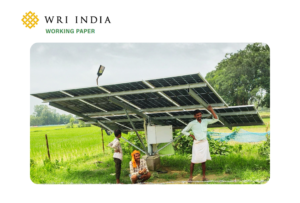
This working paper provides a first-cut assessment of how private and commercial sources can enable affordable and accessible financing for distributed renewable energy-enabled livelihood activities in India.
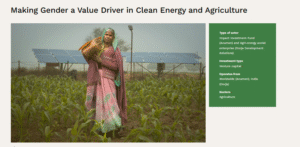
In many parts of rural India, women carry the daily responsibility of farming while remaining largely absent from formal agricultural systems. They sow, weed, harvest, and manage farms during periods of male migration, yet decisions around irrigation, technology adoption, and capital investment are typically made by others.
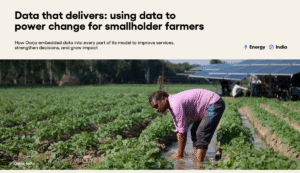
This case study explores Oorja’s approach to using data as a practical tool across its operations and impact work. It shows how insights from the field inform service design, day-to-day decisions, and longer-term strategy. The case also outlines how Oorja tracks social, economic, and environmental outcomes in a way that is useful for both teams and partners.
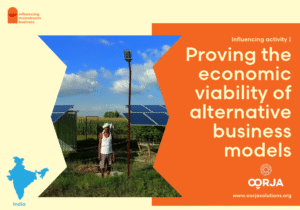
This case study highlights how Oorja is proving the economic viability of solar-powered agricultural services through its pay-per-use model for irrigation, milling, and cooling. By combining community trust-building, blended finance, and strategic partnerships, Oorja is demonstrating that sustainable farming solutions can be both inclusive and scalable for smallholder farmers in India.
This study presents the development and testing of an advanced irrigation scheduling algorithm tailored for solar-powered systems in rural India. The report offers both a technical foundation and real-world validation of a scalable solution for energy-efficient, farmer-centric water delivery.
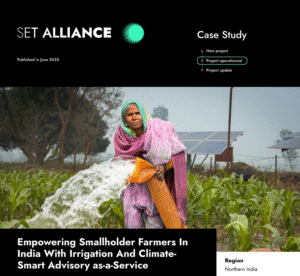
This case study is published as part of the Efficiency-as-a-Service Innovation Showcase Award presented by SET Alliance, and highlights Oorja’s transformative work in the Bahraich district of Uttar Pradesh.
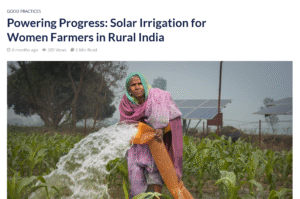
In this case study, Sejal Agarwal explores how Oorja’s Pay-Per-Use business model is transforming the lives of women farmers in eastern Uttar Pradesh by providing access to solar-powered irrigation services affordably and conveniently.
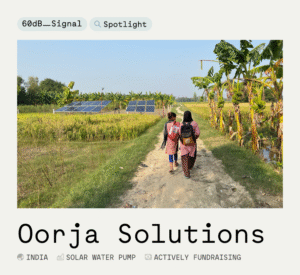
This spotlight by 60 Decibels highlights Oorja’s impact in delivering pay-per-use solar services to smallholder farmers. Farmers reported increased yields, timely irrigation, and reduced effort. The report notes over 38,000 beneficiaries, 3,800+ tonnes of CO₂e avoided, and 125 green jobs created.
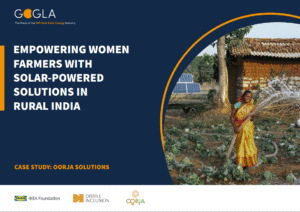
This case study by GOGLA highlights how Oorja Solutions is empowering women farmers in rural India through inclusive, solar-powered irrigation services. By understanding their unique needs and barriers, Oorja has adapted its model to boost women’s participation, productivity, and economic independence in agriculture.
Senior Manager Ankur Singh shares a detailed article favoring the Pay-Per-Use business model for its role in creating access to Productive Use of Energy (PUE) appliances in agriculture.
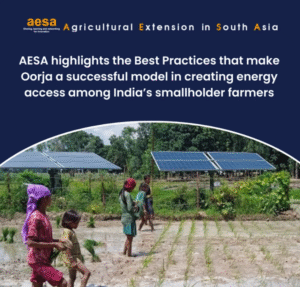
In this Good Practice Note, published by Agricultural Extension in South Asia (AESA) Argha Ghose and Ankur Singh discuss Oorja’s evolution and how it has created significant social, economic and environmental impact by strengthening farmers’ livelihoods, reducing carbon emissions and promoting sustainable agriculture.
This case study explores how Oorja is making clean energy accessible to low-income and marginalised farmers through its affordable solar farming services.
This case study focuses on Oorja’s Climate-Smart Farmer Advisory that trains smallholder farmers on modern and sustainable agronomic practices to help them fight climate change and boost farm income and crop yields.