Scaling Impact, Empowering Communities

Our mission is to drive long-term, positive change for farmers by empowering them with clean energy and advisory services.

Impact Measurement & Management

At Oorja, impact measurement is integrated into how we design, deliver, and improve our services for smallholder farmers. Our Impact Measurement and Management (IMM) framework helps us understand whether solar irrigation is improving livelihoods, strengthening climate resilience, and creating inclusive rural opportunities.

The framework is built around a few core principles. It prioritises the lived experiences of farmers, focuses on real outcomes rather than infrastructure outputs, and uses practical data systems that work in field conditions. Impact insights are continuously used to refine operations, improve service delivery, and guide strategic decisions.

By embedding impact measurement into everyday operations, Oorja ensures that evidence directly informs how we serve farming communities and scale climate-resilient irrigation solutions.

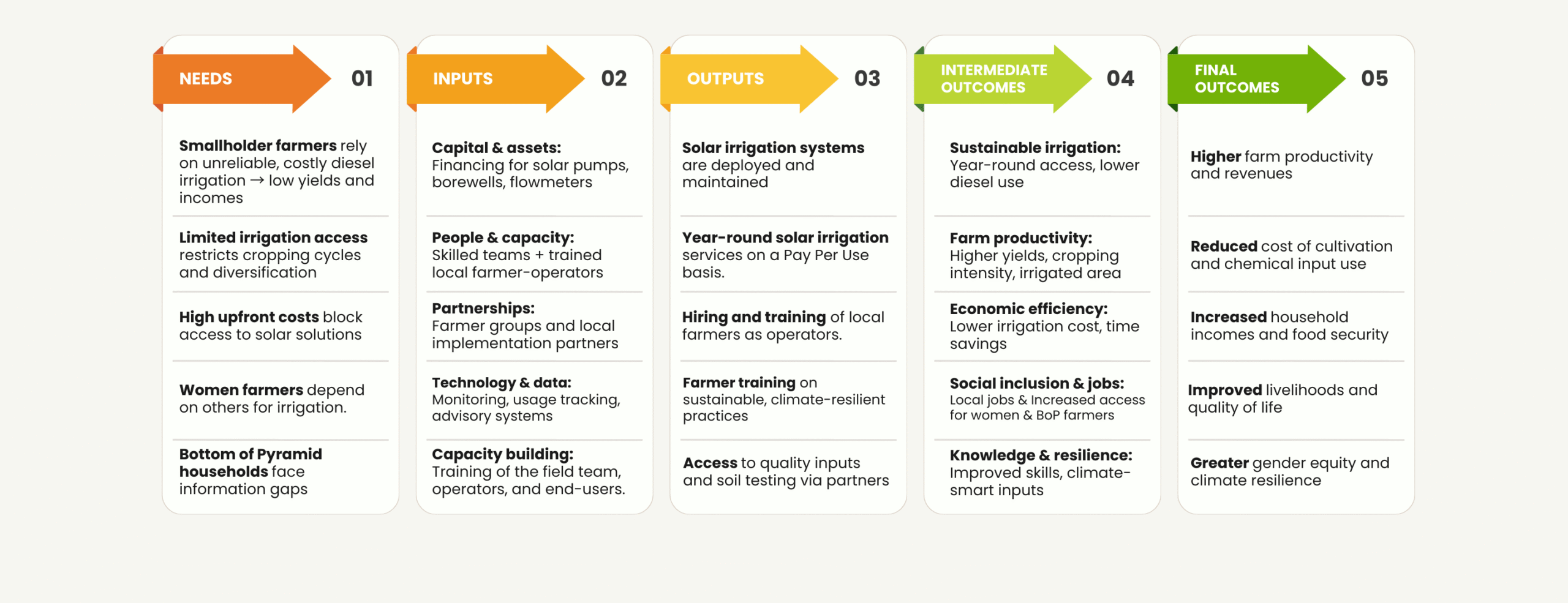
THEORY OF CHANGE

From Uncertainty to Stability

Oorja’s approach is simple: when farmers have reliable access to irrigation, timely advice, and the right support systems, they can grow more, spend less, and make better decisions for their farms and families.

By replacing costly diesel irrigation with affordable solar solutions, agronomic training, and combining technology with on-ground support, Oorja helps farmers move from uncertainty to stability. Over time, this leads to higher productivity, higher incomes, better food security, and more resilient rural livelihoods, especially for women and smallholder farmers.

FRAMEWORK

Aligning with International Standards

Oorja aligns its impact measurement practices with internationally recognised frameworks to ensure that data remains credible, comparable, and useful for decision-making. These standards guide how impact indicators are defined, measured, and reported across the organisation.

IRIS+ provides globally recognised impact indicators used by investors, development organisations, and social enterprises. Oorja maps its key performance and outcome indicators to relevant IRIS+ metrics to ensure consistency, comparability, and credibility in impact reporting.

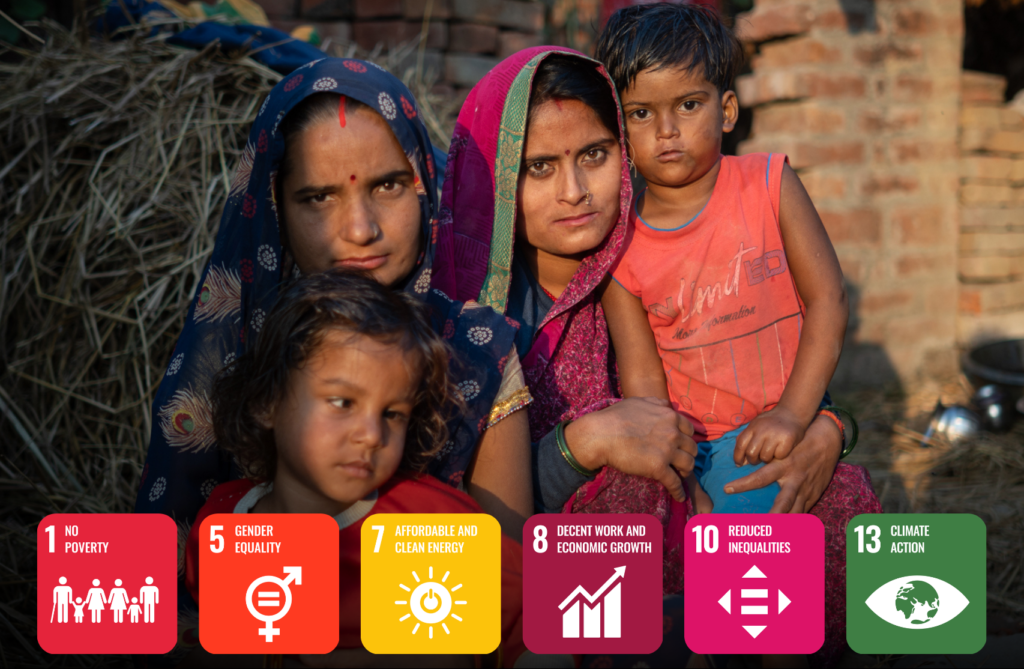
Oorja’s work contributes directly to global development priorities. Our impact indicators are mapped to the Sustainable Development Goals to situate our outcomes within broader development progress.

Oorja adopts the Lean Data approach developed by Acumen to keep impact measurement practical and farmer-focused. Surveys are designed to collect essential information efficiently while minimising the burden on farmers, enabling timely insights for programme improvement.

GENDER & INCLUSION

Building Equity into the Business Model​

At Oorja, Gender inclusion is structural, not an add-on. Our Pay-Per-Use model removes upfront cost barriers that often exclude women farmers, enabling more equitable access to irrigation. We are strengthening this approach through a five-year Gender Mainstreaming Strategy (2026–2030), embedding inclusion across customers, workforce, and leadership.

Our Commitments

30% women customers by 2030
Currently at 18%, we are expanding access through targeted outreach, women-focused advisory, and partnerships with SHGs and women-led farmer groups.

40% women workforce by 2030
From 9.8% today, we are increasing representation across roles, with a focus on field teams and last-mile operators.

62% women in senior management
Women hold key roles across leadership, including co-founders and impact functions, and are represented in governance bodies.

Empowering Women and Promoting Gender Equity

Best-in-Class Certified by 2X

Oorja is 2X Certified – Best-in-Class, the highest tier under the global 2X Gender Finance Criteria, independently verified by Value for Women (August 2025).

  • 50%+ women co-founders with active decision-making roles

  • 62% women in senior management

  • Solar irrigation services validated for positive impact on women’s agency and well-being

  • Strong systems across governance, accountability, and gender data

Safe, Inclusive Systems

Oorja’s commitments are supported by strong institutional policies, including PoSH (Prevention of Sexual Harassment), non-discrimination, equal opportunity, and equal remuneration. Gender-disaggregated data is integrated across our systems, and progress is reviewed annually under the Gender Mainstreaming Strategy.

Our Methodology

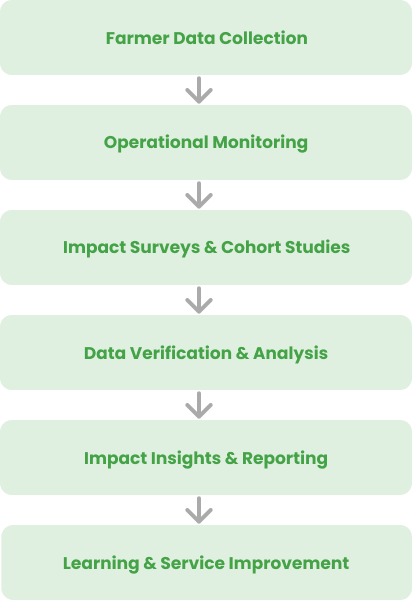
Oorja’s impact measurement system combines operational data and structured farmer surveys to understand how solar irrigation affects livelihoods, productivity, and social and environmental outcomes. Routine operational data provides insights into system performance, irrigation usage, and service delivery, complemented by periodic impact assessments that track changes in cropping patterns, farmer incomes, input costs, and adoption behaviour. Digital tools are used to ensure data accuracy, efficiency, and real-time monitoring.

For periodic assessments, Oorja undertakes cohort-based quasi-experimental studies to evaluate the social, economic, and environmental outcomes of its Pay-Per-Use solar irrigation and climate-smart advisory services. These studies combine longitudinal cohort tracking, pre-post analysis, and comparison group analysis using a Difference-in-Differences (DiD) approach to assess attributable changes.

The framework tracks two cohorts over time: (i) customer farmers from operational villages and (ii) non-customer farmers from non-operational or rejected villages, identified before installation and monitored across seasons. Insights generated feed directly into organisational learning and decision-making.

PUBLICATIONS

Latest Impact Reports

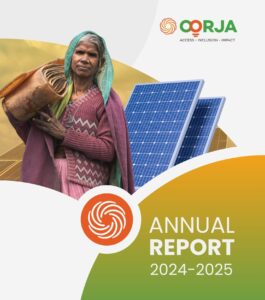
Oorja Annual Report 2024-25

Oorja’s 2024–25 Annual Report highlights work across 6 districts, reaching over 38,000 people through solar irrigation and farmer services, and shares key learnings, partnerships, and priorities shaping the road ahead.

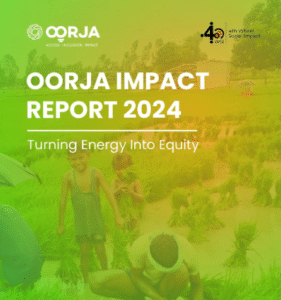
Impact Report 2024

This report captures insights from 49 villages, covering over 330 farmers, and includes a detailed Social Return on Investment (SROI) analysis showing a 4.35x return for every rupee invested in Oorja’s services in social, economic, and environmental value.

Oorja Annual Report 2023

From reaching over 120 on-farm solar projects impacting nearly 30,000 beneficiaries to expanding our team to 72 passionate changemakers, 2023 was a year of incredible progress. We secured $1 million in impact funding and welcomed mission-aligned investors to our board. We won the…

Annual Report 2022

This report captures Oorja’s work in 2022 across 7 districts, reaching over 14,000 beneficiaries through solar-powered irrigation, milling, and cooling services. It highlights a 57% average increase in farmer income, the launch of climate-smart advisory services, and early outcomes on crop diversification, diesel cost savings, and women’s participation in sustainable farming.

PARTNERS

Trusted Impact Measurement Partners

Oorja has commissioned independent external assessments from specialist impact measurement organisations to rigorously evaluate outcomes across its farmer and operator communities. Their findings have directly informed the evolution of Oorja’s impact measurement and management framework, data governance systems, and service delivery.