The Challenge
Across India, roughly 30 million farmers rely on some 9 million diesel-powered groundwater pumps to irrigate their land — machines that are as expensive to run as they are unreliable to depend on.
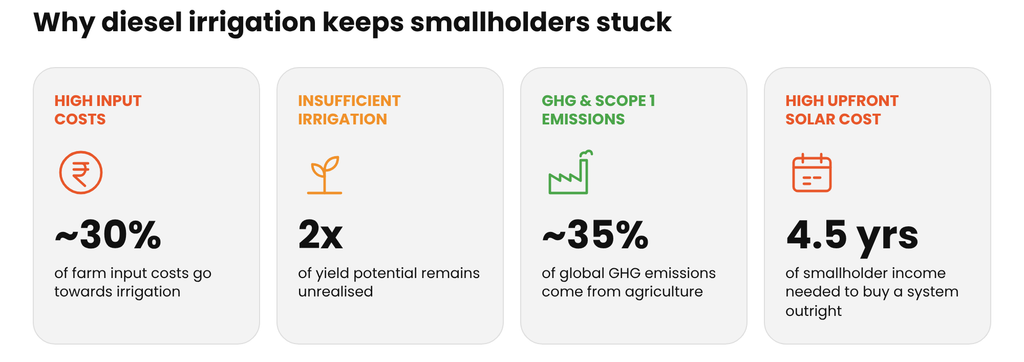
While decentralized solar technology offers an elegant escape from fossil fuels, a stubborn barrier remains: upfront cost. On average, it would take a smallholder farmer roughly 4.5 years of income to buy a solar irrigation system outright, a gap that traditional consumer financing was never built to bridge.
This financial strain has been compounded by recent global geopolitical crises and volatile international energy markets, which have driven crude oil and domestic diesel prices to unpredictable highs. Traditional consumer asset financing models require predictable, monthly, post-harvest repayments. But the reality of farming is defined by a seasonal income that only arrives after harvest. To bridge this disconnect, Oorja pioneered an inclusive Pay-Per-Use (PPU) business model for solar irrigation. By completely removing consumer debt and matching energy costs directly to a farmer’s dynamic cash flow, Oorja makes clean energy a plug-and-play reality for the last mile.
The Core Innovation: Irrigation-as-a-Service Matched to Cash Flow
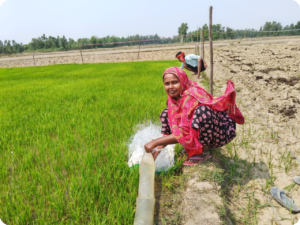
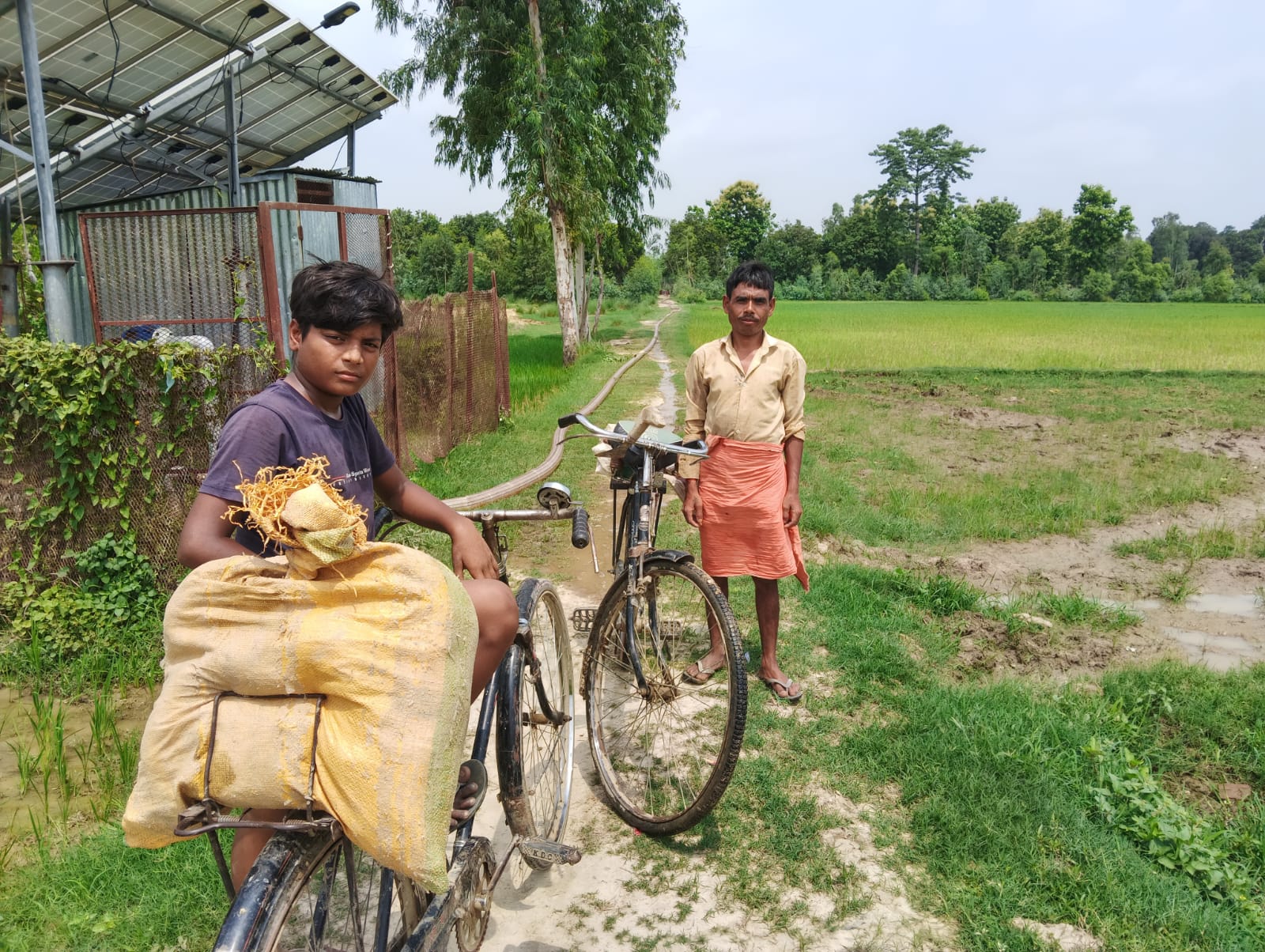
Under this Pay-Per-Use model, Oorja completely flips the script on technology adoption. Instead of selling expensive equipment on credit, which often leaves low-income rural households over-indebted, Oorja finances, deploys, owns, operates, and maintains the solar infrastructure itself for the full working life of the pump.
Farmers are not burdened with asset ownership. They simply pay a small membership fee and a low, predictable per-unit tariff for exactly the water they use, nothing more.
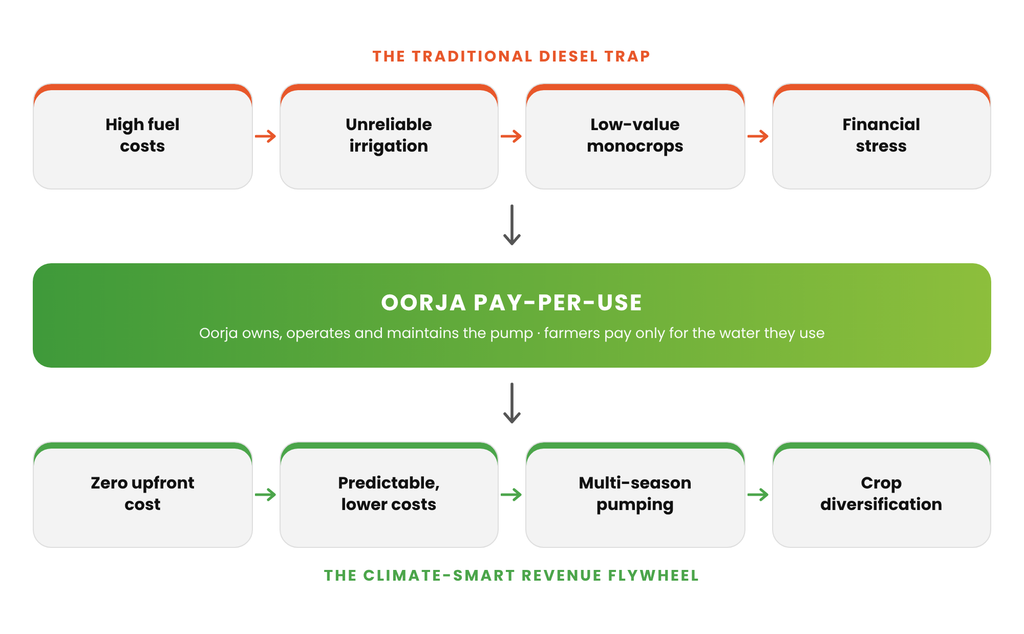
This structural shift directly removes the primary friction points that have traditionally excluded marginal communities:
- Zero Upfront Cost: Eliminates the prohibitive initial margin payments and collateral demands of private and commercial lenders.
- No Operational or Technical Risk: Oorja handles ongoing maintenance, parts, and insurance, removing the unexpected repair expenses that threaten thin farm margins.
- Hyper-Efficient Resource Sharing: Each solar pump is strategically shared across a localized group of 17 farmers on adjoining plots, maximizing land-use efficiency and pump utilization.
Farming-as-a-Service: Irrigation Paired with Advisory
Water access on its own does not guarantee better outcomes for a farmer. That’s why Oorja pairs its Pay-Per-Use irrigation service with a complementary Climate-Smart Farmer Advisory, giving farmers expert guidance and access to climate-smart inputs alongside the water itself.
- Crop Diversification: Supporting a shift in cropping patterns toward higher-value commodities.
- Agronomic Techniques: Building smallholder capacity to adopt more sustainable farming practices.
- Quality Inputs: Access to climate-resilient seeds.
- Climate Resilience: Soil health testing and weather forecasting to reduce the incidence of crop failure.
In practice, this looks like a simple three-step model: Oorja identifies sites and forms farmer groups; installs, delivers, and bills Pay-Per-Use irrigation services; then advises farmers and monitors performance season after season. Solar irrigation enables more productive farming, advisory drives the utilization that makes it count.
Comparative Advantage: Pay-Per-Use vs. Diesel
Set side by side, the structural differences between a diesel-dependent system and Oorja’s Pay-Per-Use model are stark:
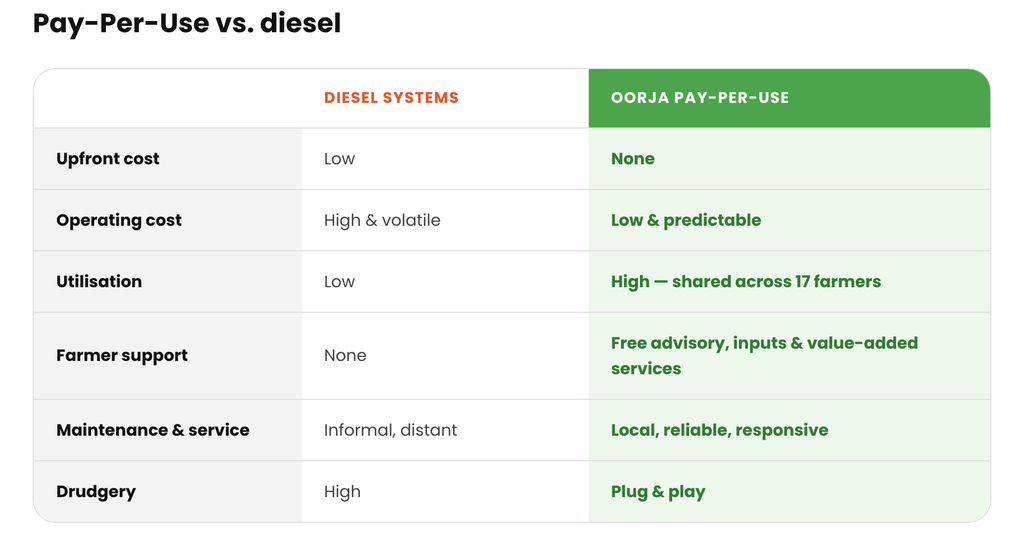
Taken together, these advantages make Oorja’s model 53% cheaper overall than running a diesel pump — without a farmer ever having to own, maintain, or finance the asset themselves.
The Investor Perspective: Turning Last-Mile Energy into Generational Equity
For impact investors, development financiers, and philanthropic partners, Oorja provides a de-risked, data-backed architecture for rural transformation. To date, Oorja’s Pay-Per-Use model has deployed 410 pumps and counting, reaching over 70,000 people impacted across more than 2 MWh of installed solar capacity, creating 236 last-mile jobs and reaching a 20% share of female users.
Based on an independent impact evaluation by 4th Wheel Social Impact, the model carries a verified Social Return on Investment (SROI) ratio of 1:4.35, meaning every rupee channelled into Oorja’s Pay-Per-Use infrastructure returns ₹4.35 in cumulative social, economic, and environmental value. Oorja customers have also reported a 31% increase in crop yield, a 27% increase in income, and a 49% drop in chemical input usage, alongside 7,500 tCO2e of emissions saved and leveraged through D-RECs. In 2025, Oorja earned 2X Certification at the Best-in-Class level, recognizing it as a high-performing, gender-smart investment.
Built to Match the Farmer’s Cash Flow: The Capital Behind the Model
Delivering this kind of service, not just hardware, is a capital-intensive proposition, and Oorja’s own funding stack is built to match it. Oorja retains ownership of every pump on its own balance sheet for its full working life, so the farmer never carries a debt burden or maintenance risk and pays only for the water they use.
That model has been backed by a blended mix of equity and grant capital: $450,000 in seed equity from Schneider Electric Energy Access Asia, followed by a $1.2 million SAFE round from investors including Acumen, elea Foundation, Artha Impact, Partners Group’s impact vehicle, Echoing Green Signal Fund, and 1to4 Foundation. Alongside this, a parallel grant and philanthropic track, including REPIC, Swiss Re Foundation, Stichting DOEN, Seeding the Future Foundation, Bayer Foundation, and MIT Solve, has funded Oorja’s geographic expansion and its farmer advisory work. Altogether, Oorja has raised over $4 million in blended finance to build a model where climate capital is patient enough to match the seasonal realities of a farmer’s income.
Partner with Oorja
To transition millions of smallholder farmers away from fossil fuels, climate capital must adapt to the seasonal realities of the field. Oorja’s Pay-Per-Use model proves that when you align clean energy infrastructure with the natural lifecycle of agricultural cash flow, last-mile inclusivity and robust scalability move hand in hand.
Explore our impact metrics and learn how we are scaling our climate-smart irrigation infrastructure across rural India. Let’s cultivate a sustainable, low-carbon future together.
Visit oorjasolutions.org or contact us at hello@oorjasolutions.org.
Written by Ankur Singh, Director – Projects & Partnerships, Oorja Development Solutions.