Agriculture is not merely an economic activity; it is the very foundation of human civilization. At its core lies a story, long under-acknowledged – the story of women. From the earliest days of food gathering and seed preservation to today’s complex agri-food systems, women have been central to sustaining farming, ensuring food security, and nurturing ecological balance.
From Invisible Contributors to Emerging Leaders
Historical and anthropological evidence suggests that women were among the earliest innovators in agriculture. They identified edible plants, developed seed preservation techniques, and contributed to the domestication of crops. These practices laid the groundwork for stable food systems and community nutrition.
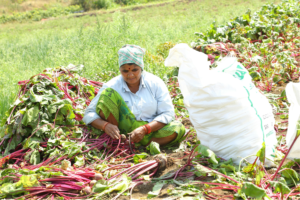
Fast forward to today, and women continue to play a critical role. According to Oxfam India (2018), women constitute over 70% of the agricultural workforce in India. They are involved in every stage of farming— sowing, transplanting, weeding, harvesting, and post-harvest processing. Yet, despite this overwhelming contribution, their work has often remained invisible in formal economic and policy narratives.
Researchers capture this paradox in what they call the “feminization of agriculture.” As men migrate to urban areas for non-farm employment, women are increasingly taking charge of agricultural operations. However, this shift has not been matched with equal access to resources or decision-making power. As per NSSO 2019, only 12.8% of land holdings are owned by women, limiting their access to credit, insurance, and government schemes.
The Rise of Collective Power
One of the most transformative developments in recent decades has been the rise of women’s collectives. The Self-Help Group (SHG) movement, which connects over 100 million women across India, has become one of the world’s largest grassroots networks. These groups have improved access to credit, enabled livelihood diversification, and strengthened women’s participation in local economies.
Women-led Farmer Producer Organizations (FPOs) and cooperatives are further enabling market access and value addition as well. Women are also stepping into entrepreneurial roles and contributing significantly to rural economic growth across dairy, food processing, and agri-enterprises. These collective efforts reflect the enduring Indian ethos of sahakarya, i.e., cooperation and shared responsibility.
Women in Uttar Pradesh: A Quiet Transformation
In states like Uttar Pradesh, where agriculture is a primary livelihood, women are increasingly emerging as key decision-makers. However, their challenges are layered—from limited land ownership and restricted mobility to limited access to modern technology.
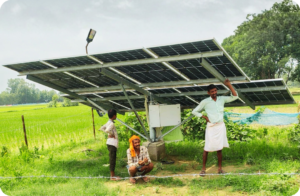
This is where organizations like Oorja Development Solutions are playing a transformative role. By promoting solar-powered irrigation systems, Oorja is not only addressing energy and water challenges but also empowering women farmers.
Enabling access to solar irrigation reduces dependence on diesel pumps, lowers costs, and ensures reliable water supply. For women, this translates into:
- Reduced physical drudgery
- Greater control over farming decisions
- Improved productivity and income stability
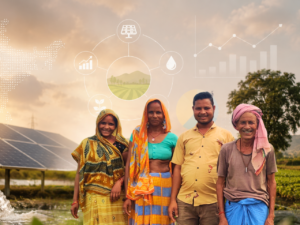
As a result of these efforts, women are now actively managing irrigation schedules, participating in farmer groups, and contributing to climate-resilient agriculture in many parts of Uttar Pradesh. Clean energy access, therefore, is becoming a catalyst for gender inclusion in agriculture.
Seeds of Change: Women as Custodians of Biodiversity
Women’s leadership extends beyond production, as they are also guardians of biodiversity. Traditionally, women have been responsible for selecting, saving, and exchanging seeds. These practices preserve genetic diversity, enhance climate resilience, and sustain local food cultures.
Organizations like Navdanya highlight that over 75% of agro-biodiversity has been lost in the past century due to industrial agriculture. In contrast, women-led seed systems continue to protect indigenous varieties adapted to local conditions.
Similarly, initiatives such as Deccan Development Society demonstrate how women farmers are creating community seed banks, preserving traditional crops, and promoting agroecological farming.
These efforts are not just about agriculture. They are also about reclaiming knowledge, ensuring food sovereignty, and building resilience against climate change.
Leadership in the Face of Climate Change
As agriculture faces increasing challenges from climate change, women are at the forefront of adopting sustainable practices. Their farming decisions often prioritize:
- Crop diversity over monoculture
- Nutritional value over yield alone
- Long-term soil health over short-term gains
This aligns closely with agroecological principles and the cultural ethos of harmony with prakriti (nature). Women are not just adapting to climate change—they are playing a leading role in the transition toward regenerative agriculture.
Bridging the Gap: From Participation to Leadership
Despite their contributions, systemic barriers persist, limited access to land, finance, technology, and extension services continues to restrict women’s potential. Addressing these gaps requires a structural shift in how agricultural systems are designed.
Key priorities include:
- Recognizing women as farmers in legal and policy frameworks
- Expanding access to credit, insurance, and government schemes
- Designing gender-inclusive technologies that reduce drudgery
- Strengthening women’s representation in farmer institutions and value chains
- Promoting education and leadership opportunities for women in agricultural sciences
Organizations like MAKAAM have been instrumental in advocating for women’s recognition as farmers, pushing for policy reforms that acknowledge their rights and contributions.
The Way Forward
The future of agriculture in India depends on how effectively it can become inclusive, sustainable, and resilient. Women are already leading this transformation — often quietly, and without recognition.
In regions like Uttar Pradesh, the integration of clean energy solutions, collective action through SHGs, and growing access to markets are creating new pathways for women’s leadership. When supported with the right resources and opportunities, women farmers can drive innovation, strengthen food systems, and build climate resilience.
The story of agriculture is, and always has been, a story of women. The task ahead is not just to acknowledge their contributions, but to ensure they have the power, resources, and platforms to shape the future of farming.
Because when women lead in agriculture, the impact goes far beyond the farm — transforming communities, economies, and generations to come.
References
- Oxfam India (2018). Status of Women in Agriculture in India.
- National Sample Survey Office (2019). Situation Assessment of Agricultural Households and Land Holdings in India.
- International Food Policy Research Institute (IFPRI). Studies on Feminization of Agriculture and Rural Transitions.
- MAKAAM. Advocacy for Recognition of Women Farmers in India.
- Centre for Science and Environment (CSE). Participatory Research on Women in Agroecology.
- Research Institute for Humanity and Nature (RIHN). Studies on Ecological and Gender Transitions in Agriculture.
- Navdanya. Reports on Agro-biodiversity Loss and Seed Sovereignty.
- Deccan Development Society (DDS). Community Seed Banks and Women-led Agroecology Initiatives.
- Food and Agriculture Organization (FAO). Women and Agro-biodiversity Conservation Reports.
- Oorja Development Solutions. Field Insights on Solar Irrigation and Women Farmers in Uttar Pradesh.
- Indian Council of Agricultural Research (ICAR). Policy and Research on Gender in Agriculture.
- Women in Indian Agriculture: From Participation to Systemic Leadership, The Economic Times (2026).
Written by Vishnu Priya Mummineni, Senior Human Resources Associate, Oorja Development Solutions.