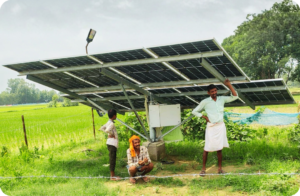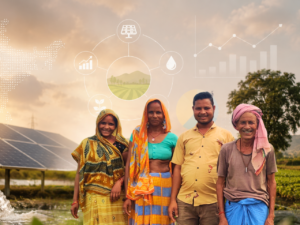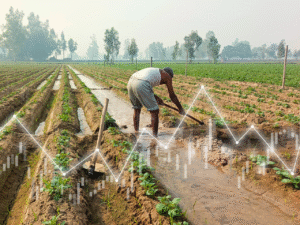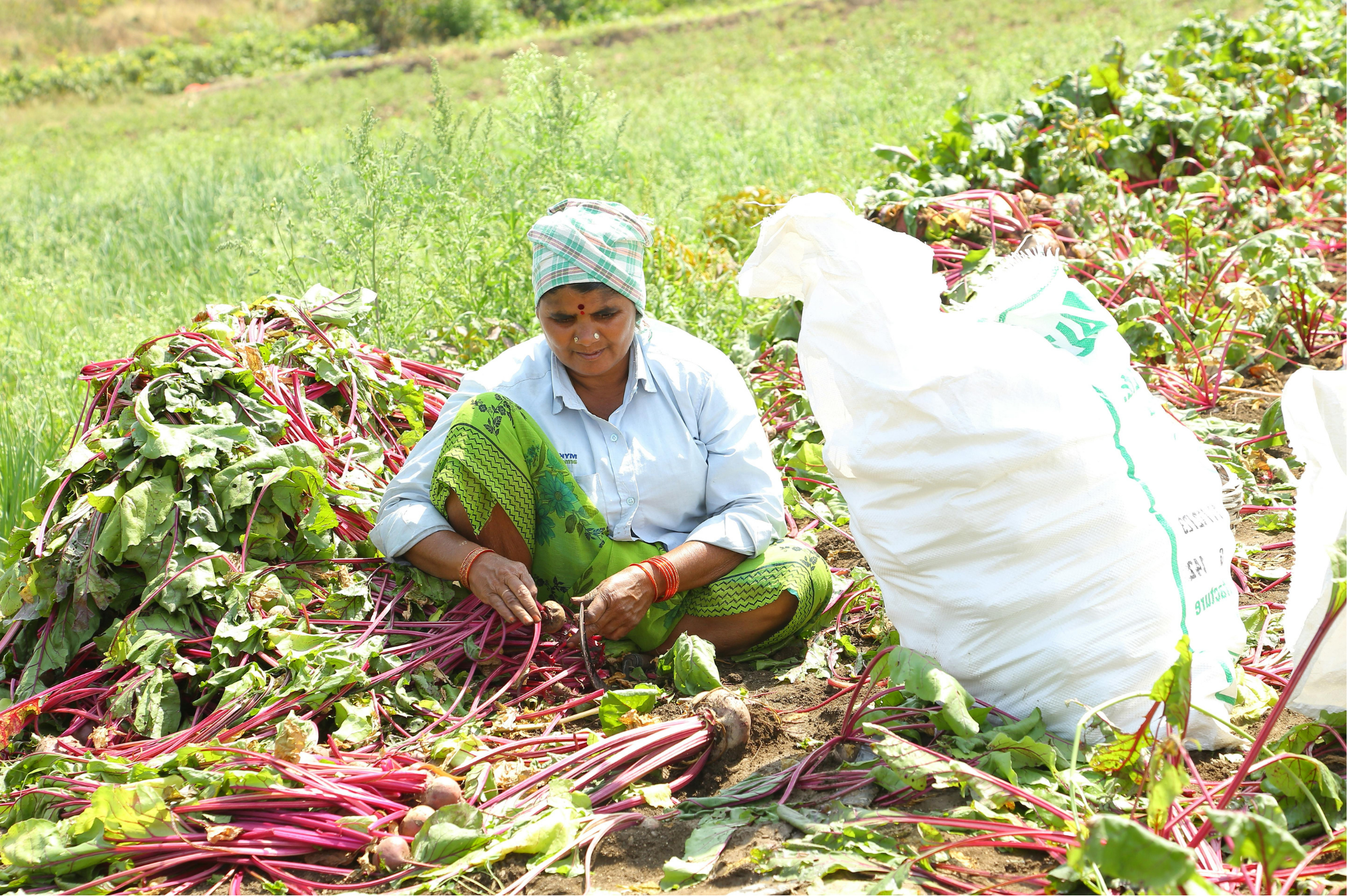
During one of my field visits, I happened to meet Anita, one of Oorja’s irrigation customers. I asked her what had changed after using Oorja’s solar pumps. She recalls one of the moments when she was standing in her paddy field on a humid afternoon in eastern Uttar Pradesh, running her fingers through a dense patch of green. The crop looked better than it had in a long time. She was able to irrigate on time. There were no last-minute calls to a diesel pump owner, no anxious waits and trouble for the labour to install the diesel pump, and no waiting at a pump to purchase costly fuel.
By most conventional measures, she witnessed a successful season. Her yields were higher.
But when I asked Anita what has actually changed, she does not talk about output first. She talks about not having to borrow money for diesel. She talks about being able to plant an additional crop. She talks about knowing, for the first time in years, that she can plan for the next season without fear of underirrigation.
“Higher yield is only part of the story. A farmer can grow more, and still remain vulnerable.”
This distinction sits at the heart of how Oorja thinks about food systems success. Yield matters; our data shows it clearly. But it cannot be the only metric. Because yield, on its own, tells us almost nothing about sustainability.
What the Numbers Actually Show
Oorja’s 2024 Impact Report, covering 333 farmers across Bahraich, Barabanki, and Hardoi, documents higher yields across all major crop seasons for customers compared to a matched comparison group: rice yields were 11.4% higher in Kharif, wheat 19% higher in Rabi, and peppermint, a high-value Zaid crop that requires consistent water supply,62% higher among Oorja customers.
These numbers are indeed meaningful. But the same report also shows something the yield figures do not: that customers retain significantly more of their harvest for household consumption than the comparison group. Rice kept for self-use rose from 29% to 36% of harvest; wheat from 28% to 44%; and customers now retain 100% of their Kharif pulses, compared to 25% in the comparison group. Meanwhile, near-total sales of high-value cash crops like peppermint (96% sold) and potatoes (86%) ensure income is not sacrificed.
The result is a model that is simultaneously more productive and more food-secure, something that yield per acre could not have captured.
The cost problem that yield ignores
In practical terms, a higher yield does not automatically mean higher profit. For farmers relying on diesel-based irrigation, cost is a constant pressure, and an unpredictable one. Diesel prices fluctuate; pump rentals add up; breakdowns at critical moments cost crops, not just money.
Oorja’s 2024 data shows seasonal irrigation costs of INR 3,730–4,714 for customers, compared to INR 5,451–5,572 for the comparison group. Customers in the comparison group with rented diesel pumps paid an average of INR 49 per hour and consumed an average of 341 litres of diesel per season, versus 224 litres for Oorja customers. The 60 Decibels Signal Spotlight confirms that reduced effort and lower irrigation costs are the most commonly cited benefits among Oorja’s customers. These data points clearly indicate that every data point is an impactful story in itself.
This cost difference is what allowed Anita to stop borrowing or worrying about high input costs. Not because she was earning dramatically more, though 89% of customers do report income increases, but because a predictable, lower cost base changes the economics of the entire farm.
Diversity, nutrition, and the limits of monoculture
Before reliable irrigation, farmers like Anita often focused on a single crop/season or a maximum of two cropping seasons to minimise risk. With predictable water access, they began to diversify. Oorja’s 2024 report documents customers cultivating chickpeas, peas, vegetables, and groundnut alongside staples, crop categories largely absent from the comparison group’s fields. This shift has led to improved nutrition at the household level, additional income streams, and reduced exposure to a single harvest failure.
The IISD’s 2026 milling study adds a complementary finding from a different part of the food system: when solar-powered mills were located close to village centres, households began processing fresh spices such as turmeric and coriander that they had previously avoided due to the difficulty of access to milling. Also, other mills usually didn’t churn smaller quantities, which was not a limitation with Oorja’s mills. The report notes this supported dietary diversification and reduced dependency on external markets. A food system that produces more of a single crop may look successful on paper. However, I believe that just like everyone likes to diversify their income sources, this is applicable to the farming community as well when they grow, process, and consume a wider range of foods and be more food secure.
Resilience: the dimension yield cannot see
For Anita, the defining change this season was not the quantity of rice she harvested. It was the fact that she did not have to worry about whether water would arrive when the crop needed it. Reliable and affordable access to solar-powered irrigation changed her planning horizon, not just her output.
This is resilience in action, and Oorja’s impact framework is built to measure it. The SROI analysis in the 2024 report calculates a return of INR 4.35 for every rupee invested over four years, combining increased income, reduced cultivation costs, enhanced food security, reduced drudgery, especially for women, and environmental benefits from lower diesel and chemical use. None of these outcomes is captured by yield per acre.
The report also tracks cropping intensity: customers averaged 198%, compared to 186% for the comparison group, despite cultivating less land on average. This is not a yield metric , it is a measure of productive confidence, of farmers willing to use their land more intensively because they trust their access to water.
Social impact and the women who are still underrepresented
As the lens widens further, the gaps in yield-centric measurement become even clearer. Over 90% of Oorja farmers report improved incomes and quality of life. Women report reduced physical drudgery;,73% now manage irrigation independently. Oorja has created more than 270 green jobs in the form of solar pump operators. These changes reshape households and communities. They remain completely invisible if success is measured in tonnes per acre.
Critically, they also remain invisible if gender is not disaggregated. The GOGLA case study on Oorja (2025) documented two distinct women customer personas, the aspirational agri-entrepreneur (women farmers working as pump operators) and the stability-focused farmer, with different needs, different barriers to adoption, and different ways of experiencing the impact of clean energy access. A food system impact framework that does not ask who is benefiting, and how, is missing a fundamental dimension.
Environmental Sustainability: The Long Tail
Maximising yield without accounting for environmental cost is a strategy that trades future capacity for present output. Groundwater depletion, soil degradation, and rising chemical inputs are the familiar consequences. Oorja’s 2024 report documents that customers used 54.9% less fertiliser and 42.4% fewer pesticides than the comparison group in Rabi, and 46.2% and 40.3% less respectively in Kharif, driven partly by Oorja’s advisory services supporting a shift to natural inputs. As of now, Oorja has been able to avoid CO2 emissions by more than 6400 tonnes.
As the saying goes, a food system that produces more today but depletes the resources needed to produce food tomorrow is not successful. It is simply extracting.
A better measure of success
I do agree that yield will always matter. For smallholder farmers facing food insecurity, higher output per acre is not a trivial gain. But it cannot remain the only measure ,not if the goal is food systems that are genuinely sustainable.
At Oorja, the measure we keep returning to is simpler than SROI ratios and cropping intensity figures, though those matter too. It is this: can Anita farm again next season, and the one after, with less anxiety and more control than the season before? That question ,about continuity, confidence, and the expansion of choice ,is what a good food systems metric is trying to answer.
Not just higher yields. Stronger, more resilient farming systems. To us at Oorja, that is what success looks like.
Written by Sejal Agarwal, Senior Manager – Impact and Projects, Oorja Development Solutions.