India is the largest user of groundwater, and solar irrigation is increasingly relevant to how the country manages agricultural water use. About 87% (Ministry of Jal Shakti) of the groundwater extracted here is used for agriculture. In India, agriculture is heavily reliant on irrigation from groundwater and monsoon rain. About 62% of the agricultural water requirements are met using groundwater in the country (Press Information Bureau). While the Annual Groundwater Recharge in India stands at 448.52 Billion Cubic Meters, the Annual Groundwater Extraction stands at 407.75 BCM. (Ministry of Jal Shakti Report, 2025). However, these national annual averages often mask the regional and seasonal variations amongst states, which also impact irrigation systems throughout the country. Moreover, owing to the rapidly changing global climatic conditions, the monsoon in India is often erratic. In a water-deficit country like India, where sunshine is abundant and fuel costs continue to rise, solar irrigation has changed from a convenient substitute for expensive modes of irrigation to a necessary means to curb fuel consumption and carbon emissions.
Throughout the years, farmers in India have relied on fuel-based irrigation systems, rendering them unable to irrigate lands in hot summers when water levels are low and fuel consumption is high. This leads to farmers leaving the land barren, while carbon emissions remain high due to fossil fuel consumption. While it is easier for medium and large farmholders to afford diesel, small and marginal farmers are limited to irrigating with only as much fuel as they can afford. Agricultural income reduces further as a result of this. To aggravate the situation, climate change and an increasingly erratic monsoon have contributed to declining groundwater levels in states like Uttar Pradesh, particularly in the pre-monsoon season, even as national annual figures show extraction below recharge (see above). This makes it difficult for small and marginal farmers to access groundwater for irrigation. In the face of such adversities, solar irrigation offers a dual solution. It targets two problems at once – it reduces the cost of irrigation by cutting fuel costs, and also promotes environmental sustainability by reducing demand for fossil fuels and curbing carbon dioxide emissions. The availability of an affordable irrigation system would increase crop diversification, crop production, and the ability for farmers to do a third season of cropping– zaid (summer season).
Oorja Development Solutions Pvt. Ltd., a for-profit organisation working in India, specifically in Uttar Pradesh, recognised these benefits of solar irrigation systems, while acknowledging the requirements of tailored implementation of the technology to meet the requirements as well as abilities of small and marginal farmers who cannot purchase and install their own solar irrigation systems. Oorja has observed that in Uttar Pradesh specifically, the shortfall of water is most acute in the pre-monsoon period, where the water table is always fluctuating and is rapidly depleting, resulting in higher fuel consumption using diesel pumps. This affects irrigation practices and consequently, crop production. As a result, agricultural income goes down, and farmers face a deficit for investment in their next cropping seasons; farmers are also limited to crops that require less water.
The issue of a high initial cost still remains a question mark for small and marginal farmers in India, who cannot afford lakhs of rupees to purchase and install a solar-powered irrigation system, albeit it promises significantly lowered costs in the long term. Oorja addresses this challenge through its Pay-Per-Use Irrigation as a Service model. It enables groups of at least 15 to 20 farmers to access solar irrigation without purchasing and installing their own systems. This also allows the company to maintain a financially viable service.
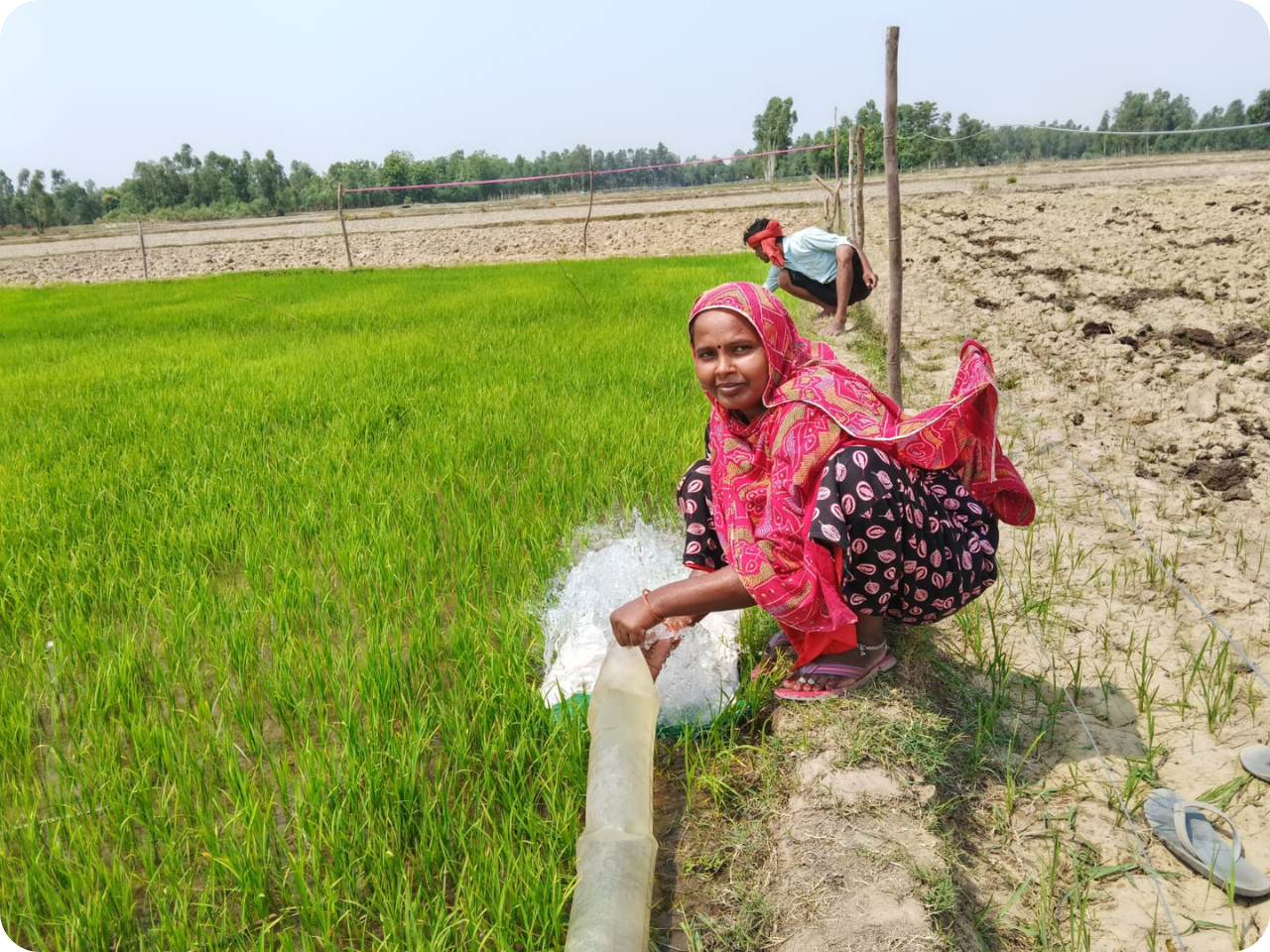
Oorja’s Pay-Per-Use model is an irrigation-as-a-service model that installs solar plants in suitable sites, designed to provide affordable irrigation to smallholder farmers. Ownership of the pump remains with Oorja, thus exempting the farmers from bearing the upfront cost of implementation, so that they can use the pumps for irrigation year-round without purchasing their own pumps. Each pump can irrigate up to 25 acres of land and can cater to around 15 to 20 farmers who become members by paying an initial nominal membership fee. Member farmers pay a minimal amount only for the water they use for irrigation, charged to them based on the fixed volumetric tariff set on the units of water they use, measured using a flowmeter and billed per cubic meter of water used. Furthermore, the model reduces overall diesel consumption and carbon emissions, increasing the agricultural income of the households.
Throughout its operation period, Oorja has catered to 188 villages, with over seventy-three thousand beneficiaries and covered over eight thousand acres of land. Diesel consumption has gone down by 47%, and over 3 lakh Litres of fossil fuel consumption was saved. Not only that, farmers have seen a 30% reduction in the cost of cultivation, all while being able to increase their number and seasons of cropping practice, thus increasing farmers’ agricultural revenue by 33%. Farmers have been able to increase their household consumption of crops, all while increasing their sales and decreasing their investment in agriculture. While fuel consumption expenditures were curbed, so were carbon emissions. Around 8,187 tons of Carbon Dioxide emissions were avoided while using solar irrigation systems, and chemical use was also reduced by about 48%, thus preserving soil health, which in turn would assist in groundwater recharge and groundwater quality.
These figures tell more than just numbers. They show the impact that the Pay-Per-Use solar irrigation service model has had not only on farmers but also in mitigating climate change. When taken together, it reflects that when irrigation stops being a barrier, farmers don’t just grow more; they grow differently. They spend less and keep more of what they earn. The shift adds up to something larger, though. It’s not just income that is saved. The system that lowers the agricultural costs of farmers also keeps carbon dioxide out of the atmosphere. It’s a unique case where farmers don’t have to choose between two benefits. Solar-powered irrigation isn’t just a cost-saving alternative to diesel; it is also a climate adaptation tool.
Written by Surasree Mukherjee, Project Analyst, Oorja Development Solutions.