A Conversation with Onkar Pandey, Director | Social Alpha
Voices of Value is Oorja’s interview series featuring leaders, practitioners, researchers, and innovators working across climate, agriculture, energy, finance, and development. Each conversation explores practical lessons from those creating impact on the ground.
For our second episode, we sat down with Onkar Pandey of Social Alpha, a leader who has spent decades bridging the gap between agricultural innovation and the farmers who need it most. The conversation was led by Ankur Singh, Director – Projects & Partnerships at Oorja.
Our first episode, with Lanvin Concessao of WRI India, began with a simple idea: start with the problem, not the solution. This conversation picks up where that one left off.
Ten Rupees and What They Meant
There is a moment that Onkar carries with him. During a field visit attended by Melinda Gates, a woman farmer from Hatipur opened her purse and handed over 10 rupees. It was not a transaction, and not a gesture of charity, but a blessing. She wanted to give something back, she said, because the technologies and innovations that had reached her village had brought economic independence to her family and community.
Ten rupees. The amount is almost irrelevant, but what it signifies is not.
This is what genuine impact looks like at the ground level: not a metric on a dashboard, but a woman farmer who felt seen and served well enough to want to reciprocate. It is also the kind of story that keeps practitioners like Onkar anchored in a field where progress is slow, systems are complex, and the distance between agricultural innovation and adoption is rarely a straight line.
The story stayed with us after the conversation, because it captured many of the themes that emerged throughout it: staying close to communities, turning agricultural innovation into adoption, and the often invisible work required to create lasting change.
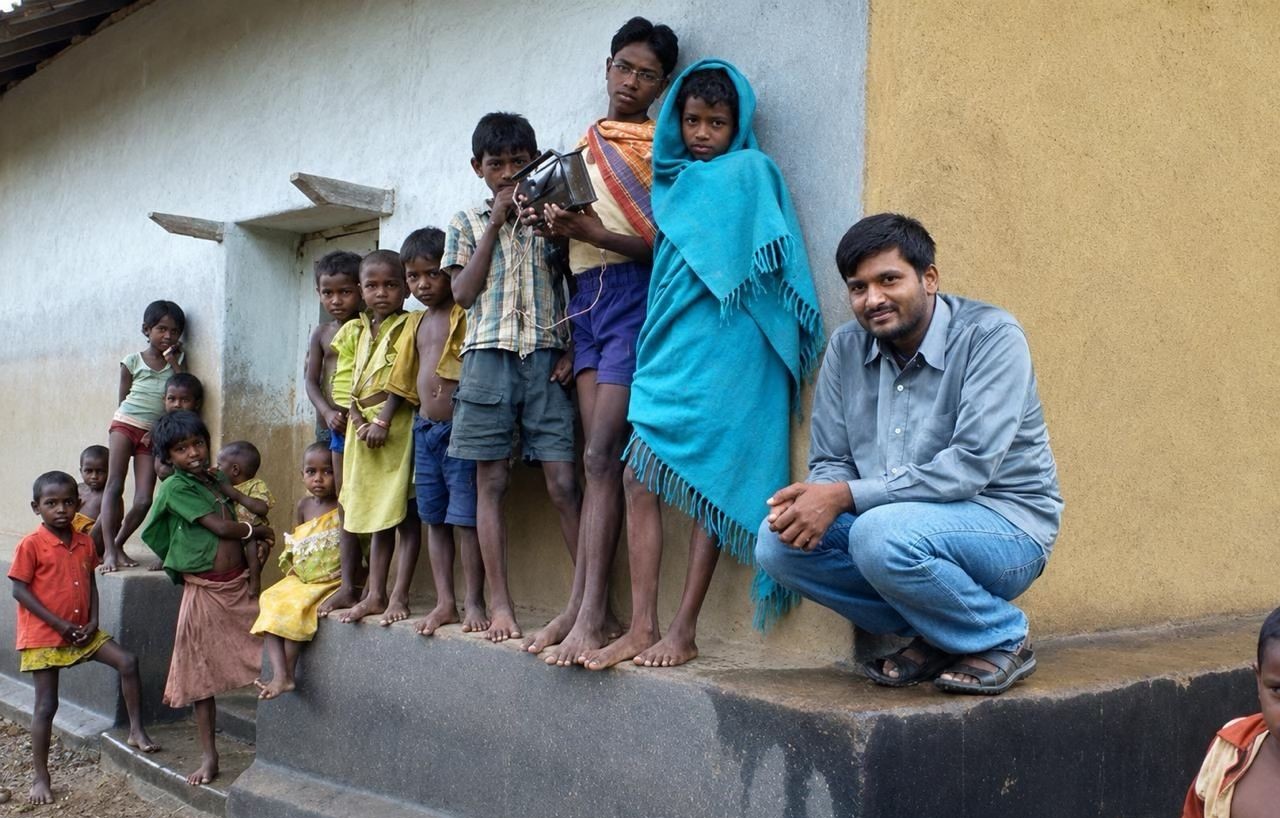
Onkar is Director at Social Alpha, one of India’s most respected science-and-society innovation platforms, working at the intersection of research and rural communities. He has spent over two decades in the development sector, beginning with grassroots work in tribal and smallholder farming communities in eastern India. He now leads programmes that identify promising agricultural innovations and help bring them to scale.
Urgent Realities in Indian Agriculture
Before discussing solutions, Onkar pointed to the scale of the challenges facing Indian agriculture. Soil degradation continues to affect productivity. Post-harvest losses erode farmer incomes before value ever reaches the farm household.
Smallholder and women farmers still lack access to tools designed for their realities. And irrigation systems that support a significant share of agricultural production remain heavily dependent on fossil fuels, while cleaner and more water-efficient alternatives struggle to achieve mainstream adoption.
For Onkar, the challenge is not that innovations do not exist. It is that too many remain trapped in research institutions, pilot projects, or isolated success stories, never reaching the farmers who could benefit from them most. Much of Social Alpha’s work is focused on closing that gap: identifying promising innovations, validating them in real-world conditions, and building the pathways needed for adoption at scale.
Feet on the Ground
One of the first things we asked Onkar was how someone at his level of institutional seniority stays genuinely connected to the communities he serves. His answer was both simple and structural.
At Social Alpha, staying grounded isn’t optional: it’s built into the model. Solutions are co-created with farmers, farmer producer organisations, CSO partners, grassroots philanthropic organisations, and government departments. Nothing moves to business planning or go-to-market strategy until it has been tested in real conditions, with real communities. The model forces contact with the field. The responsibility of leadership, Onkar says, is to ensure that contact remains honest, not filtered through layers of intermediary reporting.
It is a useful corrective to a sector that can sometimes mistake proximity to strategy for proximity to impact.
The Real Barrier to Scaling Agricultural Innovation
Perhaps the most substantive insight from our conversation was about what actually prevents good innovations from reaching farmers at scale. And Onkar’s answer challenged a common assumption: the problem is rarely the technology, and it is rarely farmer acceptance.
Farmers understand value. Show them a working pilot. Show them what a neighbour’s field produces with better irrigation. They will engage. The harder problem, Onkar argues, is the ecosystem that needs to exist around the solution.
Financing
Take any farm equipment priced between ₹40,000 and ₹50,000. That figure is beyond the reach of most smallholder farmers without financing. But convincing a mainstream financial institution to extend credit to this customer profile is genuinely difficult. The borrower is seen as high-risk, the product is new, and the return on investment is unproven in the lender’s terms.
After the sale
Add to this the post-sale challenges. Who services the equipment when it breaks down? Who trains the farmer on optimal use? Who helps a community manage shared infrastructure and irrigation scheduling during the peak season?
A product that goes to market without answers to these questions, however technically sound it may be, will fail. Innovation is only as good as the ecosystem that delivers and sustains it.
This is both a diagnosis and a design principle. The organisations that have succeeded in farm mechanisation and clean energy adoption, Onkar observes, are the ones that stayed close to their customers, built robust distribution and service systems, addressed affordability proactively, and treated the solution as just one component of a larger support architecture.
Multi-Stakeholder Collaboration Takes Time
We also asked about the challenge of multi-stakeholder collaboration; philanthropic partners, government departments, financial institutions, and farmer communities all at the same table. Onkar was refreshingly candid: it is always time-consuming and energy-intensive, and it never fully stops being difficult.
What makes it workable is alignment on the tangible. Smallholder farmers need to see concrete improvements to their production and livelihoods, not abstract metrics around emissions reductions. Philanthropic partners need to see measurable impact commensurate with their investment. Government institutions want solutions that can scale, not pilots that remain confined to one village.
The skill is not in finding a single message that satisfies all of these stakeholders simultaneously. It is in understanding which partner needs to be engaged at which stage, what their mandate requires, and how the work at that stage creates the proof of concept needed to unlock the next partner. A well-executed pilot attracts government attention. A government scheme unlocks financing. Financing enables farmer adoption at a scale that makes the commercial model viable.
Each step earns the next. Patience and sequencing matter as much as the quality of the solution itself.
Personal Journey – Discovery to Conviction
Onkar’s entry into the development sector was, by his own description, accidental. Trained in international relations and political science, he stumbled into an early opportunity with a grassroots organisation working in tribal communities in eastern India. The years that followed (six or seven of them at the grassroots level) became the most formative of his professional life.
What he learned in that period was not technical. It was human. He learned to understand what farming communities actually aspired to, not what well-intentioned development programmes assumed they wanted. He learned the difference between solutions designed from the outside and solutions built from the inside. And he internalised a conviction that has guided his work since: the goal is not to deliver to communities, but to disturb their economic comfort, in the right sense, because stagnation can erode aspiration as much as any external barrier. This needs to change in order to open possibilities that they have been excluded from for generations.
At Social Alpha, he found a model that matched that conviction: identifying innovations that emerge from research, productising them for real conditions, testing them with communities, and building the commercial and institutional bridges needed to take them to scale. He describes it as a fundamentally new kind of development model, one that did not exist in the same form 60 years ago, and one whose full potential is still being understood.
A Note for Practitioners
We closed by asking Onkar what he would say to early-stage social entrepreneurs entering the space. His advice was immediate and unambiguous:
“ Solve the problem. Revenue will chase you. ”
If the impact is real, customers will come. If customers have a world-class service experience, they will pay, they will return, and they will bring others. Growth in this space does not come from chasing scale: it comes from earning trust, one farmer at a time.
The temptation to chase funding, metrics, and recognition before getting the core solution right is real, and it is also the thing most likely to lead a promising venture off course.
It is advice that applies well beyond the water-energy-food space. And coming from someone who has watched both the successes and the failures up close, it carries the weight of genuine experience.
We are grateful to Onkar Pandey for the time, the candour, and the stories. This is exactly the kind of conversation Voices of Value was designed to surface.
To nominate a practitioner for a future Voices of Value conversation, or to learn more about the series, write to us at hello@oorjasolutions.org.