Voices of Value is Oorja’s interview series featuring leaders, practitioners, researchers, and innovators working across climate, agriculture, energy, finance, and development. Each conversation explores practical lessons from those creating impact on the ground.
A Conversation with Lanvin Concessao, Program Lead, Energy for Equitable Development | WRI India
One detail from our conversation with Lanvin has stayed with us.
In a rice mill that WRI India studied as part of its research, the entrepreneur had set up the unit to process rice and grind spices. On paper, that was the business. But the actual profits, Lanvin told us, came from somewhere else entirely, the rice husks, sold afterwards as fish and duck feed. The primary product kept the mill running. The byproduct is what made it work.
It’s a small example, but it captures something larger about how solar-powered rural enterprises actually survive, and how different that survival can look from the way it’s described in a funding proposal or a success story. It is also one of the throughlines of our conversation with Lanvin, the gap between what a formal narrative says a solution does, and what actually keeps it standing in the field.
Lanvin Concessao leads WRI India’s work on Energy for Equitable Development, one of four pillars within the organisation’s broader energy programme, alongside clean energy supply, clean energy demand, and energy minerals and circularity. He has been with WRI India since 2020, steering research that spans healthcare electrification, farm-based livelihoods, and the role of decentralised renewable energy in climate-vulnerable states including Jharkhand, Assam, Nagaland, and Mizoram.
At Oorja, we spend most of our time in the field, working with smallholder farmers, building service ecosystems, and figuring out how clean energy solutions can actually translate into better lives. But we believe that some of the most important knowledge in this space lives in people, not reports. In years of field experience, in failed pilots and breakthrough moments, in the things practitioners have learned that never make it into published research.
That’s why we are launching Voices of Value, an interview series featuring leaders and practitioners whose work has shaped how rural and climate-linked systems are built in practice. We are looking for voices that carry both strategic responsibility and close exposure to field realities. The kind of insight that is earned, not theorised.
From Energy Access to Energy for Equitable Development
We began by asking what had shaped WRI India’s shift toward this particular framing of its work. Lanvin walked us through evolution. A decade ago[LC1] , as India made broader progress toward universal household electrification, a different question emerged for the energy program to focus on. Reliable electrification of homes was happening; what about the social and economic infrastructure around those homes, the health facilities, schools, relief shelters, and agri-food systems that shape long-term development outcomes?
The pandemic sharpened that question considerably. COVID-19, Lanvin explained, moved electricity in healthcare settings from being viewed as an important input to being treated as a genuinely necessary condition, suddenly oxygen concentrators, cold storages for vaccines, and ventilators in rural and remote areas needed power that simply could not fail. That shift in urgency, paired with a deeper look at how climate vulnerability shapes both energy demand and supply, is what pushed WRI India’s framing from energy for development toward energy for equitable development: clean energy not just as a growth lever, but as a question of who gets reliable access to essential services, and who is left behind.
Lanvin shared that the question of inclusion sits behind energy for equitable development pillar’s four building blocks of work: data, technology, finance, and policy. On data, the organisation built the Energy Access Explorer, an open-source, online, geospatial platform, now recognised as a digital public good, that layer’s energy demand and supply data so that planning decisions are based on where the gaps actually are, rather than where investment has already concentrated. In Jharkhand, that same approach was used to identify 175 viable surface-water lift irrigation sites within a single block, by overlaying sunlight potential and surface water data for the state’s livelihoods department.
What formal narratives leave out
We asked Lanvin how the picture painted by published success stories compares with what WRI India hears directly from the grassroots NGOs and community partners it works with on the ground. His answer was candid: published narratives tend to highlight positive, successful interventions, but the harder and more useful conversations happen when you dig into the barriers underneath them.
Utilisation, he said, is the clearest example. A solution that irrigates one crop for one season, or processes one type of produce, rarely survives the test of year-round financial viability, even if the season in question was genuinely successful. That’s the story the rice mill illustrates: a single-product narrative looks fine on its own, but the system actually became viable once Universal Solar Pump Controllers (USPC) and multi-crop processing extended its use across the calendar, and once the byproduct economy around it was taken seriously.
The deeper issue is that technology by itself rarely answers the larger question. An irrigation pump deployed without the surrounding ecosystem, access to markets, farm inputs, extension support, storage, and transport, asks a community to shift from one rain-fed crop to three commercial crops without giving it the infrastructure that shift requires. Technology is only ever one component of what needs to work.
The constraints that keep recurring
Pressed on what specific obstacles continue to show up in solar irrigation implementation despite years of research and field experience, Lanvin pointed to several patterns. Inclusion criteria for farmers is one: systems generally require ownership of irrigable, contiguous land, and the ability to contribute to capital costs, borewells, or membership fees. Pilot sites tend to find the “perfect farmers,” those with land, resources, and willingness to pay, but scaling beyond the pilot means confronting a much more heterogeneous reality.
Operations and maintenance is another recurring constraint: insufficient village-level technical capacity to troubleshoot problems without summoning a technician from elsewhere, and the resulting case for stocking local spare parts even though higher-quality components raise upfront costs. And then there is a timing problem Lanvin described as a genuine design flaw. Solutions are often deployed first, with the business model designed afterwards, by which point communities have already settled into specific patterns of use, and it becomes far harder to introduce the discipline a sustainable model requires. Business models need to be built with flexibility as demand, cultivation patterns, and market conditions shift, not fixed at the point of installation.
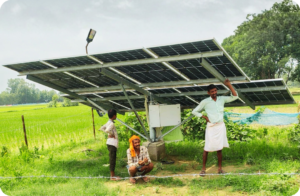
One approach he highlighted directly: in Assam, one organisation has paired community-owned solar pumps, which only allow one farmer to operate at a time, with portable solar pumps that give other farmers a redundant option. Women farmers were directly involved in co-designing the ergonomics of the trolleys used to move these portable units, a detail Lanvin returned to as an example of what gender-inclusive design looks like when it is built in rather than added on.
Measuring what actually matters
On the question of metrics, Lanvin was unusually direct about what gets left out. Quantitative data, on income, crop type, electricity bills, is relatively easy to collect and report. What tends to go missing is the qualitative layer: how satisfied people actually are with a solution, what barrier is genuinely limiting them, whether it’s water access or something else entirely. WRI India’s baseline assessments have evolved to include questions about land access for different population groups and pathways for landless farmers to participate, precisely because those qualitative gaps shape outcomes as much as the technical ones.
He also drew a distinction between short-term and long-term outcomes that has implications well beyond agriculture. In healthcare, the one-to-three-year metrics, energy generated, patient footfall, staff retention, are comparatively easy to track. The ten-to-fifteen-year metrics, shifts in maternal mortality, systemic regional health improvement, require something harder: a willingness to accept contribution rather than claim attribution, and to acknowledge that solarising a hospital does not, on its own, solve everything. The same logic applies to agricultural livelihoods, where a flood or a drought years later can reshape an intervention’s outcome in ways no original metric anticipated.
Translating data into decisions
We asked Lanvin where research most often fails to make the leap into implementation. His answer touched on something we at Oorja recognise closely: organisations accumulate rich field data, but struggle to turn it into something that actually shapes policy or program design. WRI India’s response has been to pair its formal research output, like the “Lifting All Boats” report covering 21 case studies across 9 Indian states, with an accompanying compendium that documents the technology, anchor organisation, financing model, operating model, and both positive and negative impacts for each case. The intent is to prevent other organisations and researchers from having to redo work that’s already been done, and to make sure nuance doesn’t get lost in a report that, by necessity, can only hold so much.
He also pointed to a structural gap the sector hasn’t solved: healthcare facilities, being a single building, has defined metrics that create a shared language across institutions of different sizes. Agriculture has no equivalent. Irrigation, agro-processing, and cold chains, whether that means a large cold storage facility or a small deep freezer, are measured in fundamentally different ways, which makes it difficult to compare results or build cumulative sector-wide knowledge. Standard indicators and their outcome value range are always necessary to understand and evaluate the impact of one’s services in comparison to the other companies.
Where policy and lived reality diverge
On the gap between policy design and what actually happens on the ground, Lanvin offered an example: India’s PM-KUSUM scheme, while designed for all farmers, ended up being more attractive to medium and large-sized farmers, largely because of who could afford to bridge the remaining subsidy gap. Policy, by its nature, is designed for scale, while implementation has to deal with enormous geography-specific variation, for example, the cost of a rooftop solar supply, installation, and maintenance in Mumbai bears little resemblance to the same installation in hilly Mizoram, once transportation and terrain are factored in.
Many of the costs that matter most, he added, are the invisible ones: groundwater depth, land remuneration for community projects, the time required to build trust and willingness within a community. These don’t show up in a capital expenditure line, but they alter timelines, budgets, and sometimes force a compromise on quality that comes back to undermine the system’s sustainability later. The deeper tension, as he put it, is that policies are measured against adoption numbers and installation targets, while genuine rural systems transformation depends on slower-moving factors, anchor institutions, value chain development, access to information and resources, that play out over a much longer horizon.
The Risk of Replication
Asked what blind spot deserves more attention in this field, Lanvin clearly stated: the biggest risk is assuming that a business model that worked in one geography will work in the next, because the interests, institutional support, and community acceptance that made it succeed the first time were never guaranteed to repeat. The same intervention, tested in two different geographies, can produce genuinely different results, which should give pause to anyone assuming scalability is automatic.
The discipline required, he argued, is staying technology-agnostic and flexible to local market conditions, behavioural patterns, and on-the-ground realities, rather than exporting a fixed solution and expecting it to take root in the same way everywhere.
A Note for Practitioners
We closed by asking what shifts; methodological, institutional, or geopolitical, Lanvin thought might reshape this space in the years ahead.
On the institutional shift, as the main grid continues to grow, the question is no longer whether distributed renewable energy and the grid can coexist, but how they can interact with each other. Understanding what policy, regulatory, and technological support will enable the grid to integrate and strengthen existing DRE systems, rather than displace them, will be critical. Equally important is ensuring that people in rural areas receive the same reliability, quality of power, and service standards that urban consumers increasingly take for granted, where outages can be quickly reported and resolved within hours.
On agriculture, agriphotovoltaics (AgriPV) has been positioned as a dual land-use solution that can simultaneously serve energy and agriculture production. It has the potential to ease pressure on competing land use, improve irrigation, diversify farmers’ incomes, and reduce the financial burden of agricultural electricity subsidies on utilities. At WRI India, we are particularly interested in studying these co-benefits and understanding where this model can deliver value for both farmers and agricultural productivity.
Lastly, we have learnt that even the most innovative business models work only for those who can pay. For communities at the bottom of the income pyramid, market-based solutions alone will not be enough. We will be keen to see how public, private, philanthropy, and CSR can together design financing mechanisms that address the current and future energy needs of these populations.
What he could point to concretely was a project with schools in Assam, run with the state’s disaster management agency, which revealed an assumption WRI India hadn’t initially questioned: that solarising a school primarily serves educational outcomes. In climate-vulnerable geographies, many of these same schools double as relief shelters, which means the metrics that matter (monitoring, digitisation, and shelter readiness) look entirely different from the ones a purely educational framing would suggest. It’s a small example of a larger principle Lanvin returned to throughout the conversation: “design has to follow context, not the other way around.”
His closing thought brought the conversation full circle:
“Don’t start with the solution. Start with the problem you’re actually trying to solve.”
Solar irrigation, he reminded us, is one solution within a much larger agri-food system, and the right response to that is not deeper commitment to a single technology, but a genuine openness to whatever proves most viable on the ground, technology-agnostic by design, and built to hold up over timeframes far longer than a typical project cycle.
We are grateful to Lanvin Concessao and the WRI India team for the time, the candour, and the depth of insight. This is exactly the kind of conversation Voices of Value was designed to surface.
To nominate a practitioner for a future Voices of Value conversation, or to learn more about the series, write to us at sejal.agarwal@oorjasolutions.org.