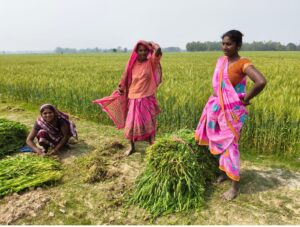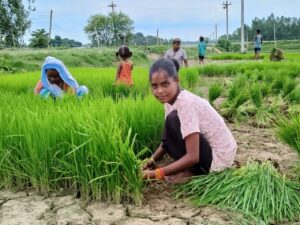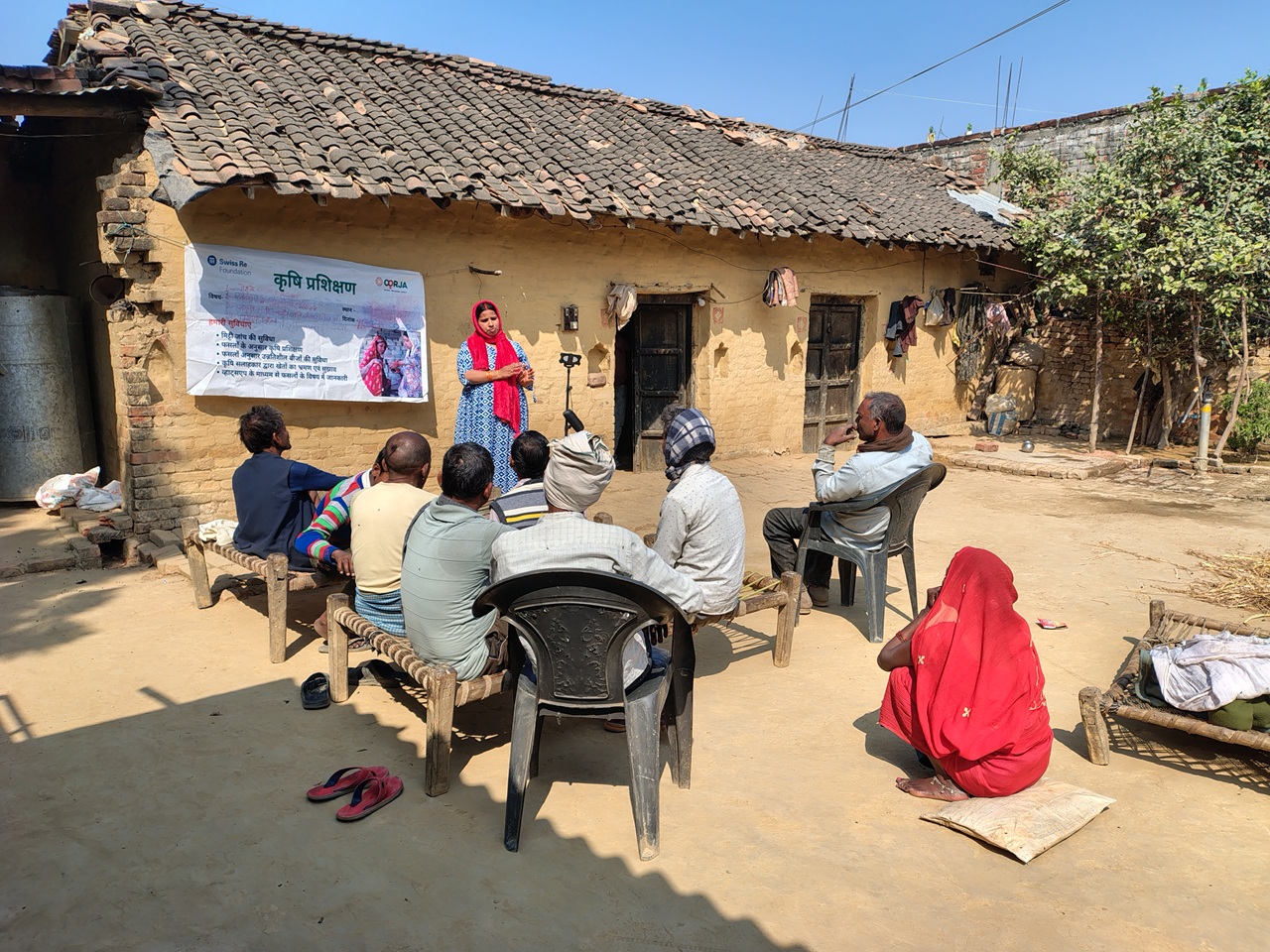
For smallholder farmers in rural Uttar Pradesh, every planting decision carries enormous weight. With limited land and resources, staying locked into traditional wheat-rice cycles has meant predictable but modest incomes with little room for growth. Oorja Development Solutions (Oorja) is breaking this cycle through an innovative combination of affordable solar-powered irrigation and comprehensive agronomy advisory services that equip farmers with knowledge, quality inputs, and the confidence to transform their farming practices.
This case study examines how Oorja’s farmer advisory service, operating across Bahraich, Barabanki, and Hardoi districts of Uttar Pradesh, is enabling crop diversification, reducing input and overall cultivation costs, and significantly increasing farmer incomes through scientific farming methods and climate-smart agriculture.
Crop diversification as a pathway to higher income
Most farmers in these districts often grow only wheat and rice, with a handful growing sugarcane, potato and pulses. However, maize has emerged as the gateway crop in the last Rabi season. For many farmers, it was the first time they planted a new crop. Farmers often hesitate to take the risk of growing a new crop. The reasons are many – lack of knowledge, quality seeds and inputs, market linkage to name a few. That said, every new crop opens new opportunities.
Farmers like Jaysaram Verma in Karaonda, Bahraich, decided to try maize along with coriander border cropping. Not only did this secure additional produce for his household needs, it opened up an entirely new income stream. Similarly, in Kishanpur village of Chitaura block, Munni Devi had always grown wheat with yields barely covering family consumption. After learning about scientific maize cultivation practices from Oorja’s advisory sessions, she decided to diversify. The shift broke a long-standing dependency on a single crop and created a new economic opportunity for her family. Over the years, we have seen a steady increase in the number of farmers willing to grow a new crop.
Quality seeds that farmers can trust
One recurring challenge farmers raised during advisory sessions was the poor and inconsistent quality of seeds available locally, often at high prices. To address this gap, Oorja coordinated seed supply in its operational areas during the Rabi season, focusing on high-quality maize varieties.
Farmers immediately noticed the difference. In Belwariya, Bahraich, Manoj Kumar Chakrabarti reported that Oorja’s maize seeds performed significantly better than the market seeds he had used earlier. Many farmers, including Jaysaram and Ramchander from Kishanpur, have already decided to continue purchasing Oorja-provided seed every season. Predictable quality is giving them predictably better yields.
This simple intervention, better seeds delivered at the right time, proved catalytic for both the adoption of new crops and better productivity.
Income improvements that matter at the household level
Improving farm income isn’t a slow, incremental process here. The combination of solar irrigation and practical advisory support is driving a noticeable jump in profitability within just one cropping season. Farmers are earning significantly more from the same land by reducing costs and increasing yields.
In Karaonda, Bahraich, Jaysaram generated an additional ₹2,500 per bigha this Rabi season. In Kishanpur, Ramchander earned ₹3,500 extra per bigha. Munni Devi saved around ₹100 – ₹120 per bigha by shifting from diesel to solar pumping, and another ₹300 through better input management. Along with increased production, this added up to ₹2,500 in higher profit per bigha.
The clearest example comes from Manoj Kumar in Belwariya. His income jumped from around ₹1,000 per bigha with wheat to nearly ₹5,000 per bigha with maize and coriander. That’s a multiplier effect that changes what farming can mean for a household. These gains allow farmers to reinvest in their land, buy more nutritious food, cover education costs, and plan for the next season with confidence.
In Semra village, Sangeeta Devi saw similar results when she adopted zero tillage for wheat. The method lowered input costs, improved plant growth, and increased yields enough to generate ₹1,200 more per bigha, while saving ₹200 on seeds.
Farmers are earning more without expanding their land or taking on new debt. Thanks to solar irrigation, quality seeds, and climate-smart agronomy for unlocking significantly higher income from the same fields.
Scientific methods are becoming the new normal
The most encouraging shift is in mindset. Farmers are not only applying new techniques on trial plots; many are planning to expand them across their full landholding.
Jaysaram intends to adopt scientific practices, including bio-inputs and intercropping across his entire one-acre farm. Ramchander is preparing to shift the full four acres he cultivates toward technical farming. Munni Devi shared similar plans, noting the combined benefits of cost reduction, yield improvement, and crop protection.
This willingness to scale demonstrates trust in the advisory support and a clear recognition of the financial benefits.
What this change signals
Farmers who once stood still are now moving forward. The success stories from Bahraich and neighboring districts show that when irrigation access and knowledge come together, farmers feel empowered to take productive risks. They diversify crops, invest in better inputs, and adopt sustainable methods that pay for themselves.
Oorja’s advisory services are helping farmers shift from low-productivity survival farming into climate-smart agriculture that builds resilience and strengthens rural livelihoods. The momentum is building, and each season adds more evidence: small changes in practices can unlock major improvements in income and food security for thousands of households.
Written by Hridya VM, Senior Project Associate at Oorja