On September 24th, Nepal’s Prime Minister Balendra Shah addressed the 81st United Nations General Assembly, placing the Bhotekoshi-Trishuli disaster at the centre of his appeal for climate justice. He called the floods a warning to the world and argued that countries like Nepal, which contribute little to global emissions, are paying a colossal price for a crisis they did not create (Kathmandu Post; United Nations).
He called for greater international support, including grant-based climate finance, and proposed a Himalayan Climate Resilience Mechanism to help countries facing escalating risks from a warming and destabilising mountain environment (Ministry of Foreign Affairs, Government of Nepal)
He spoke to our governments. I’m writing to the rest of us: people who, like me, live in the wealthy countries of the North. What happened in the Himalayas on 26 August has much to do with the way we live.
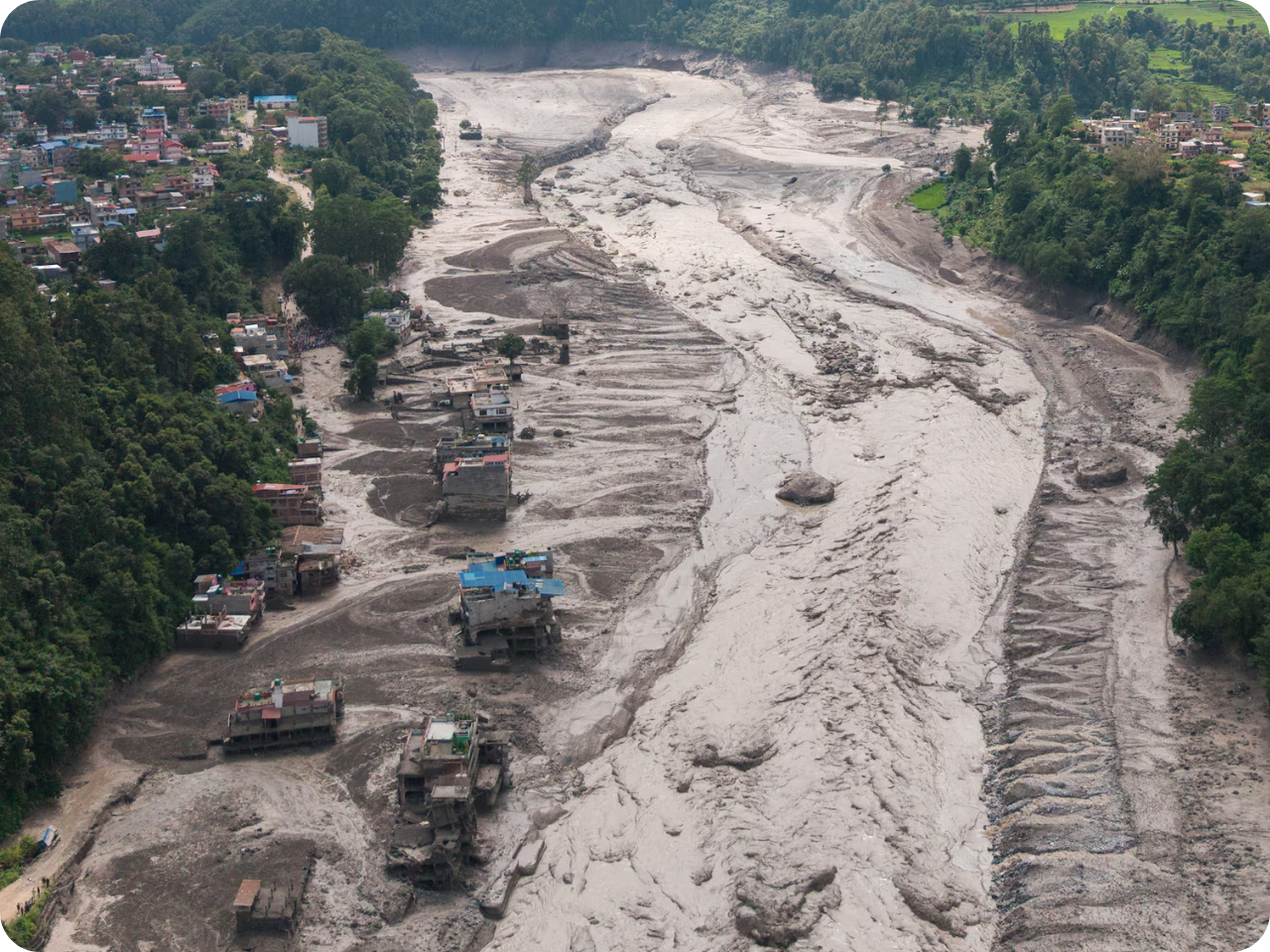
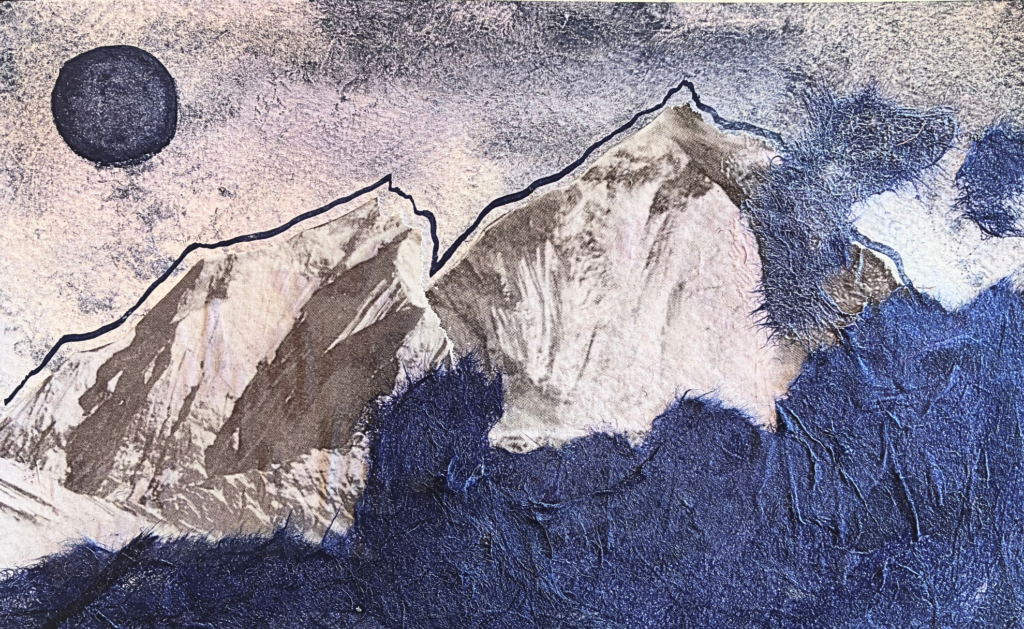
That morning, on Langtang Lirung in northern Nepal, around 2 square kilometres of rock wall and glacier ice broke away from the mountain (Reuters, via US News). The impact was so violent it registered as a magnitude 5.2 tremor (ESA). In the high gorges, water, ice and rock rose at least 70 metres above normal; further down, the river climbed roughly 9 metres in 30 minutes (Britannica). The debris flow travelled nearly 100 km down the Lende Khola and Trishuli rivers (USGS).
The Bhotekoshi flooded at around 8:40 am. The Prime Minister ordered search and rescue at 8:45; local authorities put riverside areas on high alert at 9:00 (Rising Nepal). For the families along the Trishuli, it was already too late.
What happened to the mountain?
Mountains don’t fall for no reason. This one had been coming apart for years.
The World Weather Attribution group found that climate change is highly likely to have contributed to the collapse. Rising temperatures thinned the glaciers and melted the ice and permafrost buried deep inside the Himalayan bedrock (Reuters, via US News).
Warming has pushed the altitude at which ground stays frozen upward by roughly 100 metres per decade (NBC News). At around 5,000 metres, instruments now show some ground no longer stays frozen through the year, according to geoscientist Jakob Steiner (Phys.org / AP). Glaciers in the region have been thinning by about half a metre per year since 2000 (Reuters, via US News). The Langtang Lirung glacier has retreated about half a kilometre since the 1990s, exposing rock once covered by ice (KSAT / AP).
Other factors played a part: unusually heavy snowfall last October and November (Reuters, via US News), unusually warm weeks before the collapse (PBS / AP), and the 2015 earthquake, which may have weakened the rock years before (Phys.org / AP).
Climate change didn’t act alone. It spent decades removing what held the mountain together, and the researchers say its fingerprints are clearly visible (Phys.org / AP).
What did the water take?
As of 16 September, Nepal’s disaster authority had recovered 1,403 bodies, and 6,150 people were still considered missing, after a verification exercise raised the figure from 5,179 the day before (Courthouse News / AFP). Across the border in China, 43 people died, and 519 are missing (Courthouse News / AFP). Several hundred foreigners, including tourists and pilgrims, are among the missing (Jamaica Observer / AFP). Army teams have been breaking through hydropower tunnels to search for workers trapped inside (Mappr). More than 300 vehicles waiting at the border were swept away (The Diplomat).
84,270 people across 19,284 households were affected (UN News). The flood displaced entire villages across Rasuwa, Nuwakot and Dhading (UN Nepal); by early September, 3,652 people were living in 39 relief camps (Nepal Press). The government’s Rapid Damage and Needs Assessment counts nearly 4,800 businesses and 7,570 homes damaged (Kathmandu Post). In Rasuwa alone: 1,500 private houses, 28 public buildings and 14 bank offices destroyed (Radio Nepal).
And everything that connected these valleys to the rest of the world:
- Roads and bridges: 41 km of road swept away in Rasuwa (Radio Nepal); 32 bridges completely washed away across Rasuwa, Nuwakot and Dhading, including the Friendship Bridge at Rasuwagadhi (Khabarhub).
- The border: Gyirong Port, Nepal’s primary trade and tourism gateway with China, completely destroyed. Nepal no longer has a fully functional crossing with China (The Diplomat).
- Schools: 18 damaged, 11 of them completely destroyed (Radio Nepal).
- Farms: paddy destroyed across 1,669 hectares, 5,843 tonnes of rice lost, and Rs 1.11 billion in livestock and poultry losses (myRepublica).
Then the energy. 13 hydropower projects and five solar plants, 759 MW of capacity, were damaged, with Rs 151 billion in losses to hydropower and transmission alone, the costliest sector in the assessment (Kathmandu Post). Roughly 431 MW of generation was cut from the grid (Spotlight Nepal).
Hydropower accounts for 95% of Nepal’s installed electricity capacity (Kantipur, quoting the Nepal Electricity Authority). Nepal built an electricity system powered almost entirely by renewables. Climate change has just washed a large part of it down the river.
The bill: Rs 408 billion in damage and losses (Kathmandu Post). Rs 723 billion needed for recovery, roughly 34% of Nepal’s national budget for the year (Spotlight Nepal). Nepal now estimates reconstruction at $4.78 billion (Courthouse News / AFP).
How thin is the thread?
Numbers like these hide what matters most. Who absorbs the loss?
Around 76% of people in the affected municipalities were already living with above-average vulnerability before the flood (UNDP). Across Nepal, 20.27% of the population lives below the poverty line, and 24.66% in rural areas (Nepal Economic Forum, citing NLSS-IV). 13.5 million people live on less than $6.85 a day (World Bank). The World Bank has estimated that 45% of Nepalis are vulnerable to falling into poverty (World Bank).
Much of what keeps families above that line comes from abroad. Remittances made up 22.82% of GDP in 2022/23, and around 90% of that money goes on daily consumption (Nepal Economic Forum). Very little is left to build a buffer.
So when a shock hits, we know what happens next, because it has been measured in Nepal before. After the 2015 earthquake, households coped first through remittances, then borrowing, then selling assets (Raut, Progress in Disaster Science, 2021). In drought-hit areas, more than three-quarters of households borrowed to eat, over a third sold farm and household assets, 18.5% sold land, and half had at least one day a week with no meal at all (weADAPT). During the COVID lockdown, rural household debt nearly doubled (University of Illinois).
Every one of those strategies trades tomorrow for today. Land sold doesn’t come back. Debt taken to eat has to be repaid from a harvest that no longer exists.
The World Bank’s Unbreakable report found that disasters force some 26 million people into poverty every year (World Bank). Its lead author, Stéphane Hallegatte, put it simply: the same loss affects poor and marginalised people far more (Capital FM / AFP).
Winter is approaching in these high-altitude communities (UN Nepal). What happens in the next few months will decide whether this is a terrible year, or the start of a trap that lasts a generation.
Who put the carbon in the air?
In 2024, the average person in Nepal emitted 0.63 tonnes of CO₂, and the whole country accounted for 0.05% of global CO₂ emissions (Our World in Data). The average person in the United States emitted 14.2 tonnes (Our World in Data). In France, 3.97 tonnes within our borders (Our World in Data); count everything we import and consume, and the average French footprint reaches 8.2 tonnes of CO₂ equivalent, half of it emitted abroad (Selectra, citing France’s SDES).
Look beyond countries and the gap widens. In 2019, the richest 1% of the world’s population produced as much carbon pollution as the five billion people in the poorest two-thirds (Oxfam). That 1% is 77 million people (France 24 / AFP). And flood death tolls are seven times higher in the most unequal countries (Oxfam GB).
Our flights, our cars, our consumption: the emissions are ours. The floods land somewhere else.
Nepal’s government said it plainly in its request for international support: the country “contributes negligibly to global greenhouse gas emissions”, yet carries disproportionate and escalating impacts (JURIST).
And still, the financing may fall on Nepal. Experts expect the country may need soft loans to fill the funding gap (Kathmandu Post). Globally, about 58% of adaptation finance arrives as loans (UNEP Adaptation Gap Report 2025, summary). Developing countries will need $310 to $365 billion a year for adaptation by 2035; international public flows were $26 billion in 2023, down from $28 billion (UNEP, via Central Asia Climate Portal).
Then there’s the UN Fund for Responding to Loss and Damage, created for exactly this. Nepal sent it an urgent request on 31 August. The fund’s co-chairs replied that they were engaging the Board to respond as rapidly as possible (Kathmandu Post). Separately, Nepal has been approved for $20 million under a pilot window, based on proposals submitted before the flood; the money still has to clear a review process before release, and the emergency request is still awaiting a decision (Kathmandu Post). The fund’s pilot rules cap individual grants at $5 million to $20 million (Ground News briefing).
$20 million, against a $4.78 billion reconstruction bill.
So the people who emitted least lose their homes. And then their country borrows to rebuild them.
Why did Blatten have days?
In May 2025, a glacier collapsed above the Swiss village of Blatten. Rock formations had moved 17 metres in three days, and authorities evacuated the village (NASA). About 90% of Blatten was buried; thanks to early warning systems, all 300 residents had left days before (Airbus). One man, who was not among the evacuated residents, went missing (The Nightly / AFP).
In Nepal, the dead and missing number more than 7,500.
Same kind of event. The difference is whether a country can afford sensors on the slopes, scientists reading them, and the means to act. The risk reaches every mountain village. The protection follows the money.
What comes after 1.5°C?
The Paris Agreement drew a line at 1.5°C. In 2024, the planet reached 1.55°C above pre-industrial levels, and the WMO now gives a 75% chance that the 2026 to 2030 average will exceed 1.5°C (Red Cross Red Crescent Climate Centre, citing WMO).
And El Niño is back. The WMO says it is set to become very strong, raising the risk of extreme weather into 2027 (WMO), with an increased chance that 2027 becomes the hottest year on record (Climate Home News). Nepal’s Department of Hydrology and Meteorology expected it to weaken this year’s monsoon over South Asia, including Nepal, with higher temperatures across the country (B360 Nepal). The farming families who just lost their harvest to a flood may face drought next.
In the mountains, the trend is set. Himalayan glaciers melted 65% faster in the 2010s than in the decade before, and could lose up to 80% of their volume by 2100 under worst-case scenarios. Their ice feeds 12 rivers supplying two billion people in 16 countries (CNN, via KTVZ).
We have seen this before. Pakistan, 2022: over 1,700 dead, more than $30 billion in damages, nearly 10% of GDP, in a country responsible for less than 1% of global emissions (SAIS Review). A year later, donors had funded only 68.2% of the $816 million response plan (Center for Disaster Philanthropy).
Langtang will not be the last. It is thus our duty, those of us on the comfortable side of this divide, to stop treating each disaster as an isolated tragedy and start treating it as a debt.
What can we do today?
The fight for fair climate finance will take years. Nepal’s Prime Minister is carrying it to the UN today. But families in Rasuwa, Nuwakot and Dhading need help now.
The UN’s $49.6 million flash appeal, a four-month plan to reach over 84,000 people before winter (UN Nepal), had raised $22 million a week after launch (JURIST). The Government of Nepal has appealed to citizens, organisations and institutions to contribute to the Prime Minister’s Natural Disaster Relief Fund (Nepal Ministry of Home Affairs).
You can donate directly on the official portal, which Nepal’s embassies are directing people to and which accepts international cards (Embassy of Nepal, Malaysia):
You can donate directly on the official portal, which Nepal’s embassies are directing people to and which accepts international cards (Embassy of Nepal, Malaysia): pmdrf.nchl.com.np
For larger amounts that your card won’t accept, the portal lists SWIFT bank details (PMDRF portal). Please give through the official portal. Several independent, non-government sites have also appeared since the flood, such as helpnepalflood.com and nepalrelief.fund; the government’s own portal is the safest route.
We are the ones who can afford to give. Give what you can, and share this with someone who can too.
Written by Audrey Fillon, Chief Business Officer, Oorja Development Solutions.