At Oorja, data and feedback have never been an afterthought. It is a core part of the organisation’s culture and core values. From the outset, we built internal feedback loops; monthly data collection, seasonal surveys, service assessments, field-level monitoring into how we run the organisation and our services. So, when we participated in the 2023 60 Decibels Inclusive Energy Opportunity, we were not starting from zero. What the 60 Decibels assessment added was additionality in the truest sense, an independent perspective that sharpened our picture, challenged assumptions we held, and equipped us to tell our impact story with greater credibility externally.
The Case for an External View
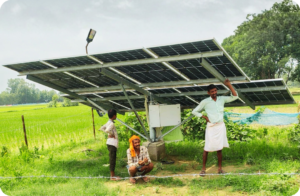
Oorja’s Irrigation as a Service model removes the single biggest barrier to solar irrigation adoption: upfront cost for the BoP smallholders. Farmers (Customers) access solar-powered water on demand and pay per litre of water consumed, with no capital outlay, no maintenance burden, and no dependence on diesel for the farmers. We knew that the model was working. Internal surveys, however well designed, have a credibility ceiling with external audiences; the data is ours, and funders know it. Independent validation was always going to be a different category of evidence. The 60 Decibels assessment, rigorously designed, independently administered, with no involvement from us, gave our impact numbers exactly that: a foundation that third parties could stand behind.
What the Data Confirmed and What It Corrected
The headline findings validated our core model.
- 89% of customers accessing solar water pump for the first time
- 97% of customers without access to a good alternative
- 34% of customers reported higher farm productivity.
- 94% reported an improvement in quality of life.
- Close to two-thirds reported a reduction in weekly household expenses.
One of the most consequential findings came from a detail we had not independently verified. We had been calculating beneficiary reach using an assumed household size of six, standard in the region. The 60 Decibels survey found the actual average in our communities was 7.4 members, a 23% upward revision. We had been systematically undercounting the lives our work was reaching and impacting. We updated our methodology with an externally verified basis following the assessment.
The data also surfaced two areas requiring strategic action. First, women farmers, despite being central to agricultural labour in our districts, were underrepresented as direct service users. We responded by redesigning our onboarding to actively include women as independent subscribers, regardless of land ownership. Women now make up 20% of Oorja’s Irrigation Customers (as of March 2026), with an aim of increasing it further to 30% by 2030 as we scale the model. Second, a subset of customers flagged delays in service access. We reviewed our operator protocols and made targeted process improvements. This is how third-party data should work, not as a report card, but as operational intelligence.
How the Data Unlocked Funding
In the months after the report was published, we integrated the findings across all our external communications – funding applications, partnership conversations, and sector events. The effect was clear.
Swiss Re Foundation, one of our largest grant relationships to date, reviewed the 60 Decibels report as part of their funding application review from Oorja. Third-party verification transformed our impact claims, not because our internal data was lacking, but because independence is a credibility that cannot be self-assigned. That conversation led to one of the biggest grants we have received. Read about the project here.
The findings also supported our application to 2024 Global Climate Challenge by MIT SOLVE, through which Oorja became one of the top 6 SOLVER finalists globally – which in turn opened the door to Seeding The Future Grand Prize award, another landmark grant awarded to Oorja in 2025.
What the data changed was not just the outcome of these conversations, but the way we told our impact story and thereby their quality. When a funder sees that 93% of your customers report higher incomes — verified by an organisation with no stake in the number — they stop questioning the methodology and start asking about the model. That is a fundamentally different, and more productive, conversation.
From 3,300 Users to 5,500 and Growing
At the time of the survey, Oorja had approximately 3,300 direct users. We now serve over 5,500 across 320+ pumps in six districts of Uttar Pradesh. That growth has been accompanied by a deepening of how we use data — as we scale across new geographies, we are building the analytical infrastructure to turn operational data into real-time decisions.
The 60 Decibels experience reinforced something we now hold as an organisational principle: impact data is not a reporting obligation. It is a strategic asset. When collected rigorously and used actively — to make decisions, to correct course, to tell a credible story, it compounds. It builds the trust that unlocks the next conversation, the next partnership, the next phase of growth.
As we look to scale, we are actively engaging with funders and investors who share our belief that rigorous impact and sustainable business models go hand in hand. Write to me ankur.singh@oorjasolutions.org.
Good data does not just confirm. It directs.
The 60 Decibels impact assessment of Oorja was conducted as part of the Inclusive Energy Opportunity programme. The full report is available on Oorja’s Reports and Publications page.
About the Author
Ankur Singh is a Director at Oorja Development Solutions India Private Limited working across grant fundraising, partnerships and project management. He is a management professional with over nine years of experience across renewables, livelihood, gender and poverty alleviation. He is a post graduate from Institute of Rural Management Anand (IRMA).
Nadia is a Senior Marketing Associate at 60 Decibels, working across campaigns and content spanning impact investing, microfinance, agriculture, and off-grid energy, and more. She joined from an early-stage sustainability startup, and holds a BSc in Business Management and Spanish from the University of Southampton.
About the Organisation
Oorja Development Solutions is an award-winning social enterprise transforming smallholder agriculture in India through Oonnati — a pay-per-use solar irrigation service that gives farmers reliable water access with zero upfront cost. By replacing diesel pumps with solar, Oonnati cuts irrigation costs, delivers higher crop yields, and has helped farmers improve their quality of life. To date, Oorja has impacted over 40,000 lives, avoided over 6,300 tonnes of CO₂ emissions, and created meaningful last-mile rural employment. Recognised as a 2X Best-in-Class organisation, Oorja is now scaling rapidly with an ambition to impact 1 million farmers by 2035.
60 Decibels is the world’s leading customer insights company for social impact. With a network of more than 1,700 researchers across 110+ countries, they bring reach, speed, and repeatability to social performance measurement. Using advanced data collection techniques and AI analytics, 60 Decibels measures and benchmarks impact performance, helping its clients – investors, Fortune 500 companies, and NGOs – make informed, data-driven decisions.
By Ankur Singh, Director, Oorja Development Solutions, in collaboration with Nadia Kassam, Senior Marketing Associate, 60 Decibels