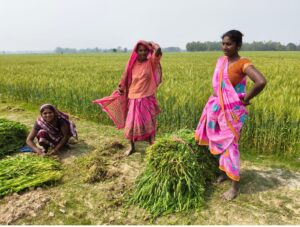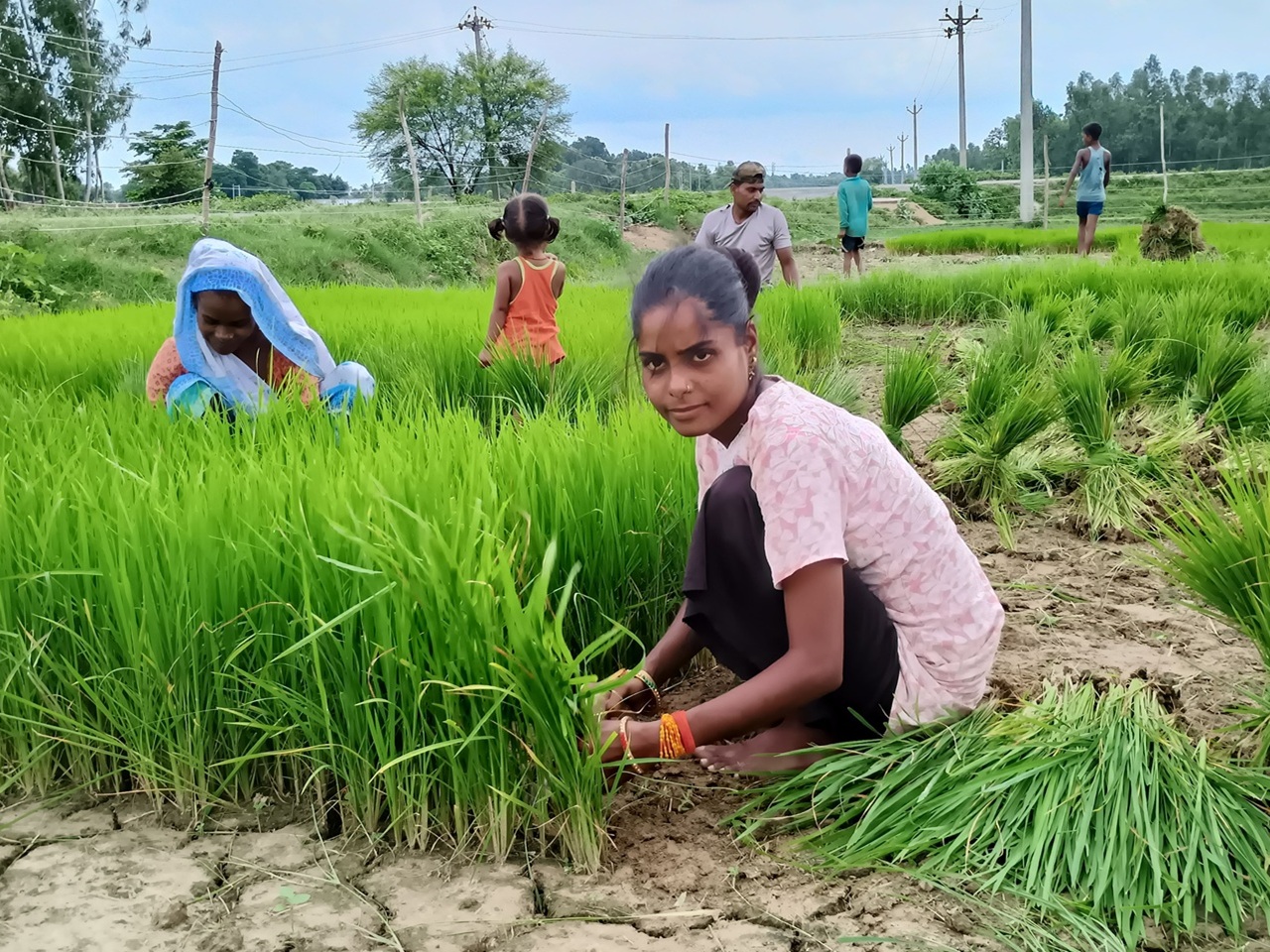
Recently, we conducted a household survey in the Fatehpur blocks of Barabanki district in Uttar Pradesh. One of our goals was to understand how women felt about becoming water entrepreneurs. The responses we received revealed deep-seated barriers that prevent women from taking up the role, even when opportunities are available to them.
When we approached women with the idea of becoming water entrepreneurs, managing irrigation systems or water distribution services, most of them responded with doubt and hesitation. The first question they asked was, are they even capable of doing this? These were women who had been managing households and working on their farms for years. Yet, they genuinely doubted their ability to handle water entrepreneurial roles. This lack of confidence wasn’t just modesty. It came from years of being told, directly or indirectly, that certain types of work, especially those involving money, labour-intensive or public interaction, were not meant for them.
Education emerged as another major concern. Many women told us they were not educated enough to manage such work. What they failed to see was their own practical knowledge about farming, water management, and community needs. They had years of hands-on experience, but because they lacked formal education, they didn’t value their own skills. This educational insecurity stopped them from even trying roles they could easily learn with some basic training. This shows the importance of skill development in rural areas. When introducing interventions in the rural context, training is essential to build confidence.
The responsibility of taking care of the family was another huge barrier. Adding any new work to this already heavy load seemed impossible to them. What was striking was that the women themselves raised this concern, showing how deeply they believed that household care was their job alone, not something to be shared with other family members.
Perhaps the most disappointing response we heard was, the male member of the household will do it. Even when we were specifically talking about opportunities for women, many preferred to let their husbands take over. This showed how deeply traditional gender roles are embedded in these communities. Women have come to believe that men are naturally better at business and financial matters. They have accepted these roles not necessarily because they agree with them, but also because challenging them can bring social problems.
In households with large farmlands, the relatively well-off families, we saw a different problem. Here, male family members actively discouraged women from working outside and earning money. Their reasoning was straightforward: “We are earning enough from their farms, so why should women also work?” In these families, keeping women at home became a matter of family pride and status. The ability to keep women from working was seen as a sign of prosperity. So while poor families often push women into farm work out of necessity, wealthy families use their prosperity to justify keeping women confined to the home. Either way, women’s choices remain limited.
These barriers matter deeply for agriculture. In many parts of India, women do most of the agricultural work. Nearly 80 percent of economically active women are employed in the agriculture sector, and women constitute about 40 percent of the total agricultural workforce (India Development Review, August 2025). Yet they are routinely excluded from training programs, access to new technologies, and entrepreneurial opportunities. This is not just unfair to women; it directly undermines agricultural productivity and growth.
The women we met in Barabanki are not lacking in ability or intelligence. What they lack is support and recognition. They need families and communities that believe in their capabilities, share household responsibilities more fairly, and treat mistakes as a normal part of learning. They also need training programs that go beyond technical skills, programs that build confidence, create peer support networks, and engage entire families to challenge long-held beliefs about what women can and cannot do.
Until these deeper issues are addressed, self-doubt, fear of social judgment, and status-based restrictions, women farmers will continue to face barriers that have nothing to do with their actual capabilities. The problem is not the technology or the opportunity itself, but the social context in which women are expected to live.
Real change will require more than providing resources. It will require changing mindsets, redistributing responsibilities, and creating space for women to try, fail, learn, and succeed without the scrutiny men rarely face. Only then can we unlock the full potential of women farmers and build a more productive and equitable agricultural sector.
Oorja’s experience with women operators shows that when given proper support and opportunity, women can excel in these roles. Currently, Oorja works with five women operators. Operators are selected based on basic education, their ability to write farmers’ names and do simple mathematics like multiplication and subtraction to record pump utilization data. Oorja provides training on their responsibilities and the work process. One example is Shanthi Devi, a high school-educated woman whose husband agreed to let her become an operator. However, recognizing the barriers women face, Oorja initially appointed her husband as the operator for the first two and a half months. During this time, all the recording and daily work was actually given to Shanthi Devi, and Oorja staff visited regularly to observe her work. This training period allowed her to become comfortable with the responsibilities without the immediate pressure of being the official operator. After two and a half months, she took over completely and has been managing everything independently for the last nine months.
What Oorja has observed is that when women are given responsibility, they are often more sincere and committed to getting the work done properly. In Shanthi Devi’s case, customers who had been delaying payments for months started paying on time once she became the operator. Oorja staff noted that customers seem more willing to pay without delays when they deal with a woman operator. Shanthi Devi herself has been very sincere in following up with customers who have pending payments, calling them regularly and ensuring they clear their dues. Her dedication and efficiency became so evident that when there was a discussion about changing the operator, a poll was conducted in the village. The majority of villagers voted for Shanthi Devi to continue as the operator, citing her efficiency and sincerity. This response shows that when women are given a chance to prove themselves, communities can be welcoming and supportive, recognizing merit over gender.
In general, Oorja has found that women who are already engaged in community activities or have some experience interacting outside their homes adapt more easily to these roles. However, with proper training and support, most women can take on operator responsibilities. After all, they are already managing households and involved in agriculture, adding the operator role is manageable with the right preparation and gradual introduction to the work. The key is creating that initial space for women to learn and build confidence, as Oorja did with Shanthi Devi, rather than expecting them to perform perfectly from day one.
Written by Hridya VM, Senior Project Associate at Oorja.