WRI India just published a working paper on financing distributed renewable energy (DRE) for livelihoods in India, and Oorja was one of the enterprises interviewed for it. Reading through the findings, I kept nodding along, because it puts language to a lot of what we live day to day.
Here is the short version of the problem: solar pumps are the kind of asset that genuinely changes a smallholder farmer’s income. But it sits in a strange financing gap. It is too capital-intensive and too field-heavy for standard microfinance. It is too small, too rural, and too slow-growing for standard venture capital. And banks, quite reasonably, want to see credit history, collateral, and predictable cash flow, none of which a smallholder farmer working monsoon-dependent land in a place like eastern Uttar Pradesh can easily offer. The districts we work in (Bahraich, Barabanki, Sitapur, Hardoi and Lakhimpur) sit in the Terai belt, with fragmented, sub-two-hectare holdings, heavy dependence on diesel pump-sets for irrigation, and household incomes that typically are below $100 a month. Standard lending logic was simply never built with this context in mind, and the mismatch shows up everywhere in the sector, including in policy.
Take PM-KUSUM, India’s flagship solar pump subsidy scheme. It was designed with good intentions: reliable daytime irrigation power, a real cut in diesel dependence, and for its grid-connected components, a genuine income opportunity for farmers able to sell surplus power back to the DISCOM. On raw numbers, the standalone pump component has genuinely delivered, with more than 1 million pumps installed by mid-2026. But a recent Frontline investigation into the scheme put language to something we see constantly on the ground: installing a pump is a very different achievement from building a farmer’s lasting access to water. The scheme still asks the farmer to be the owner, which means the farmer also carries the debt, the maintenance, and the breakdown risk, and eventually the cost of a pump that has fallen outside its warranty window. We’ve seen panels taken off their mounts and carried home to power a household instead of a field, because nobody stayed around long enough to explain how to look after it, and the cost of maintaining it long term was simply not taken into account. That ownership structure quietly favours farmers who already have land, collateral, and enough of a financial cushion to absorb the risk. There’s a second, subtler problem too: once a farmer owns the pump outright, the marginal cost of running it drops close to zero, so there is little financial reason to use water carefully, and in already water-stressed districts that can quietly turn a climate-positive scheme into a groundwater problem. This is exactly where an operator like Oorja sits differently: because we retain ownership and charge per cubic metre of water actually used, deployment risk never lands on the farmer, and the tariff itself keeps the incentive to use water efficiently. As the Frontline piece puts it, the real question for India’s solar transition is not how many megawatts get installed, but who ends up owning them. And, in the words of an industry expert with more than two decades in the field, the truth is the farmer never wanted a pump or a kilowatt in the first place, they wanted water.
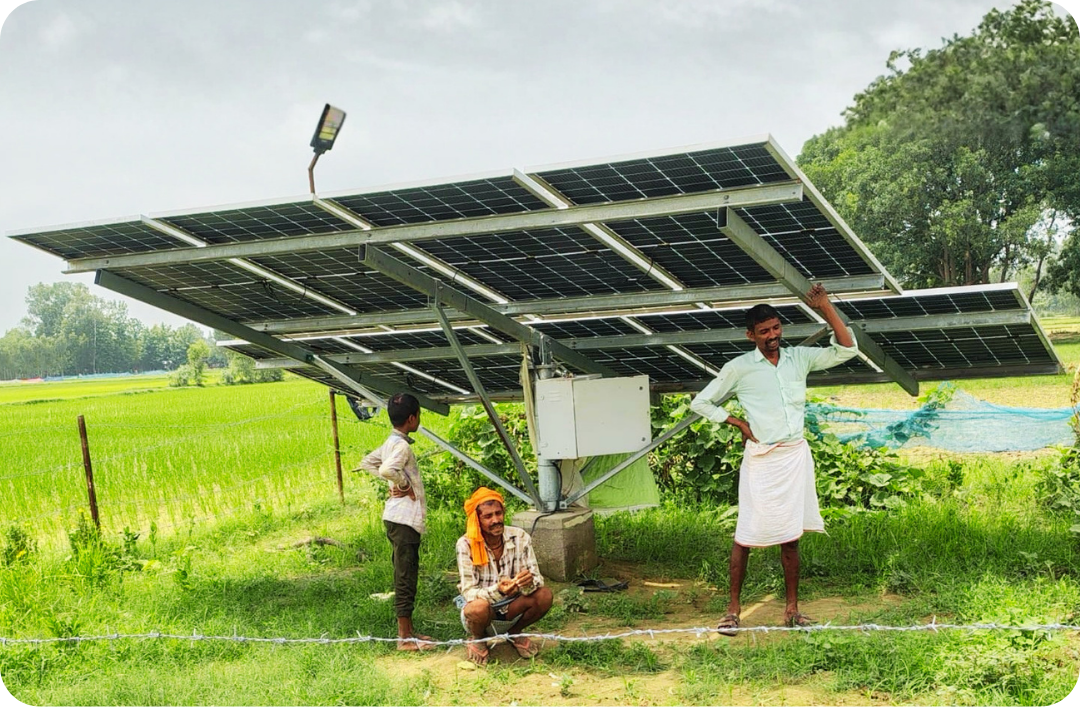
That is the piece I think the WRI paper gets exactly right and I’d like to push further: financing tied only to the equipment, without financing tied to the underlying livelihood activity, creates unrealistic expectations. A pump is not income in and by itself. Several different models have emerged in this space to try to solve that gap, each making a different trade-off. Hardware manufacturers sell a pump outright, at subsidised or full cost, and the farmer takes on ownership and maintenance from day one. Loan-based models let a farmer borrow to buy a pump and resell water to neighbours, which works well for households with enough creditworthiness and appetite to carry multi-year debt against a harvest-dependent income. PAYGO ownership models, the kind we’ve seen work well in East Africa, bundle the pump with agronomic advisory and a repayment plan, though the repayments still need to be made by the farmer over several seasons. Each of these expands access in real ways. Where we’ve chosen to position ourselves is a step further along that spectrum: Oorja keeps asset ownership on its own balance sheet for the full 15-year life of the pump, so the farmer never carries a debt burden or maintenance risk at all, and pays only for the water they use.
What makes the service-based model work is the layer we bundle around it. Every site comes with access to soil testing, seed provision, and hands-on training from our own agronomy team, delivered season after season for as long as a farmer is with us. A farmer who has irrigated the same low-value crop for a decade does not become more profitable because the water source changed. One of our farmers in Bahraich, who had left his land idle every summer for years, used that season for the first time this year to grow black gram on land that had sat empty, guided by our advisory team on timing and organic inputs, and earned real income from it in a season that used to earn him nothing. That is what accompanying a farmer through a cycle looks like in practice, and it is also, frankly, an expensive proposition to deliver well. It is exactly the kind of cost that a pure equipment financing model has no way to price in or recover.
This is why our own capital stack looks the way it does. We started with $450,000 in seed equity from Schneider Electric Energy Access Asia, followed by a $1.2 million SAFE round from Acumen, elea Foundation, Artha Impact, Partners Group’s impact vehicle, Echoing Green, and 1to4 Foundation. Alongside that, we’ve built a parallel grant and philanthropic track through REPIC, Swiss Re Foundation, Stichting DOEN, the Seeding the Future Foundation, Bayer Foundation, MIT Solve and others, which has funded both our geographic expansion and the farmer advisory add-on that further strengthens the irrigation service. Altogether we’ve raised over $4 million in blended finance. None of it could have gotten us here alone: while the equity built the team and the technology, the grant capital funded the growth and the advisory work that makes the equipment actually productive. And it is this blended base that has taken us to where we are today: over 7,000 active subscribers and 410 pumps on the ground, close to 2 MWh equivalent of installed capacity, in some of the most remote and infrastructure-poor parts of eastern UP.
We’re now living through exactly that gap that I’d call the messy middle: post-seed, post-revenue, generating real profit at the pump level, but not yet at Series A scale. Globally, there is no shortage of capital earmarked for exactly this kind of impact. What is missing at our stage is an instrument actually shaped for what a business like ours looks like. We’re still actively building out our base of aligned impact equity investors at this stage, people and institutions who understand what an asset-heavy, field-based social enterprise actually looks like and are willing to back that thesis this early, and we’re grateful for the handful we’ve already found. Longer term though, we think the sector needs to get better at separating two jobs that too often get folded into a single raise: equity to fund the team, the technology, and the pace of expansion, and dedicated infrastructure debt to fund the pumps themselves, hard assets with a 10 to 15 year useful life and a 5 to 7 year payback period, once there is enough of a track record to underwrite against. Right now the debt market hasn’t caught up with what a company at our stage actually needs: tenors of 5 years or more, pricing that reflects the quality of the underlying asset rather than early-stage company risk, and lenders willing to underwrite against the long-term cash flow of pay-per-use farmer contracts instead of demanding the collateral or track record that only exists once the capital has already arrived. Ecosystem partners often default to one of two options, a grant instrument that can’t scale alongside commercial growth, or standard commercial debt terms built for companies with years of audited history behind them. Companies exactly at our stage sit in the space between those two options: too commercial for concessional capital, too early for standard commercial debt. Through our REPIC-backed programme, we’ve been working with BASE, the Basel Agency for Sustainable Energy, on SPV structuring that would let us ring-fence pump-level assets and start attracting that kind of patient, project-level debt once we have enough operating history behind us. It is exactly the direction the sector needs more of: instruments built to match how these businesses actually sustain and grow, slowly, on the ground, one pump and one farmer relationship at a time.
WRI’s recommendations, first loss default guarantees, aggregation models to cut transaction costs, and dedicated financial products built around a farmer’s income-generating potential, describe the exact difference between a farmer getting access to affordable irrigation and a farmer being priced out of it.
We are grateful to WRI India for taking the time to talk with us and to put this evidence in front of the people who can act on it. Financing rural DRE at scale was never going to happen through any single instrument. It takes exactly the kind of blended, patient, and flexible capital this paper is calling for, financing that funds the whole service: the water, the advisory, and the trust built with a farmer over many seasons.
Full WRI Report: Financing Distributed Renewable Energy for Livelihoods in India through Private and Commercial Sources
Written by Audrey Fillon, Chief Business Officer at Oorja.